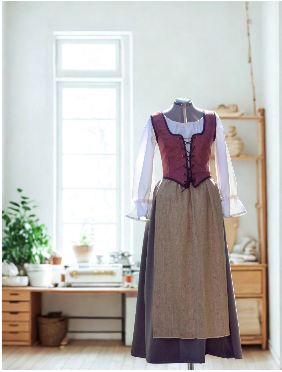
A Dress Form: Every Dressmaker's Best Friend
A good sewing dress form is one of the most useful tools in a dressmaker's atelier. Whether you make clothes for yourself, create historical costumes, work on cosplay commissions or sew garments for clients, a dress form can make your work considerably easier.
But what exactly should you look for when buying one?
First, an important distinction: we are not talking about the mannequins you see in fashion shop windows, designed primarily to display clothing. We mean a sewing dress form, also known as a dressmaking mannequin or tailor's dummy. These are specially designed for fitting, draping, pinning and adjusting garments.
There are many different models available, from simple adjustable dress forms to professional, fixed-size forms used in couture ateliers. For a beginner, the choices can be rather overwhelming.
Do you really need all those adjustment wheels? Is a professional model worth the investment? And what makes one dress form better than another?
Let's have a closer look.
My absolute favorite:
Why Every Dressmaker Needs a Dress Form
A dress form is much more than a convenient place to hang a dress while you are working on it.
It allows you to examine your garment from every angle, check the proportions and see how the fabric behaves. You can pin, drape, adjust and mark your work without constantly having to put the garment on yourself or ask someone else to help.
One of its greatest advantages is that you can step back and look at your work from a distance. This gives you a much better impression of the overall silhouette, balance and proportions.
It is particularly useful when working on:
-
Dresses, skirts and fitted bodices.
-
Historical costumes and period clothing.
-
Corsets and structured garments.
-
Coats, jackets and tailored clothing.
-
Hemlines and skirt lengths.
-
Draping and pattern development.
And what about the back of a garment?
Even if you are very flexible, fitting and pinning the back of your own clothing is rather difficult. A dress form makes this much easier.
For anyone making made-to-measure clothing, it is also a practical way to check the construction throughout the sewing process.
However, there is one important thing to remember: a dress form is a working tool, not a replacement for a real fitting. The human body moves, bends and changes shape. A mannequin cannot reproduce all these things.
Adjustable or Fixed-Size Dress Form?
This is probably the first decision you need to make.
Adjustable dress forms
Adjustable dress forms have several turning wheels or adjustment mechanisms. These allow you to change measurements such as the bust, waist and hips.
Some models also offer adjustments for the neck, back length and body length.
They are particularly useful if you sew for different people or work with several garment sizes.
However, there is a limitation.
An adjustable dress form does not automatically reproduce every possible body shape. Increasing the bust, for example, does not necessarily give you the correct shoulder width, back shape or bust position.
The adjustment range is also limited. You cannot simply turn a small dress form into an extra-large one, or expect an XL model to become an accurate XS form.
Always check the actual measurement range before buying.
Fixed-size professional dress forms
Professional dress forms are often available in specific sizes and proportions. They are not necessarily adjustable, but they can offer a more accurate and stable shape.
For couture work, this can be a considerable advantage.
A dress form that closely matches the measurements and proportions of your client is often more useful than an adjustable model that only approximately matches them.
Professional dressmakers sometimes use several fixed-size dress forms in their atelier, each dedicated to a particular size or client.
For custom-made clothing, another possibility is to use a standard dress form and adapt it with padding to reproduce the measurements of an individual client.
This is particularly useful when working with non-standard body proportions.
What Should You Look for When Buying a Dress Form?
There are several important details to consider before making your purchase.
1. Choose the correct body shape
Do you need a women's or men's dress form?
Although there are also more gender-neutral models, most manufacturers still classify their dress forms according to traditional men's and women's body proportions.
This matters because the differences are not simply a matter of measurements. Shoulder width, chest shape, waist position and hip proportions are all important.
Choose a form that is suitable for the type of clothing you intend to make.
2. Check the size and measurement range
Do not buy a dress form simply because it resembles your own clothing size.
Clothing sizes vary considerably between manufacturers, and a dress form's measurements are much more important than the size printed on its label.
Compare the bust, waist, hips, neck and back length with the measurements you actually need.
If you regularly make clothing for clients, consider which sizes you work with most often.
3. Look at the adjustment possibilities
If you choose an adjustable dress form, check how many measurements you can change.
Bust, waist and hips are obvious, but there are other important measurements to consider:
-
Neck circumference.
-
Back length.
-
Front length.
-
Waist position.
-
Shoulder width.
-
Bust height and position.
-
Hip and body proportions.
The more possibilities you have, the more versatile your dress form will be.
Remember, however, that more adjustment wheels do not automatically mean a more accurate fit.
4. A stable stand is essential
This is something that is easily overlooked when buying a dress form.
Some models have a stand consisting of three separate legs or tubes. Although these can be perfectly stable when assembled, they are not always convenient when you need to move the mannequin.
If your dress form has to be moved regularly around your sewing room, look carefully at the construction of the stand.
A sturdy, well-designed base is a worthwhile investment.
Also check whether the height can be adjusted. This is particularly important when marking skirt hems or working on long dresses and historical costumes.
5. Choose a suitable fabric covering
The fabric covering is more important than you might think.
You need a surface that allows you to pin your fabric securely without making it unnecessarily difficult to remove the pins.
A good covering also helps prevent garments from slipping while you are working.
Some dress forms have a soft, textured fabric covering, while others have a smoother surface.
If you intend to use your dress form frequently for draping and fitting, pay particular attention to this detail.
6. Consider the colour
This may seem like a minor detail, but it can make a difference in your atelier.
A black dress form can look elegant, but it is not always the easiest background when working with dark fabrics.
A grey or neutral-coloured model is often more practical, particularly when photographing your work.
If you use your dress form as part of your studio presentation, you may prefer something more distinctive.
There is no right or wrong choice here. Practicality should come first.
7. Accessories: which ones are useful?
Some manufacturers offer additional accessories.
One particularly useful option is a trouser or pants adapter.
This allows you to work on trousers and skirts without constantly removing the body of the dress form from its stand. Depending on the model, it also makes it easier to position and adjust the trouser legs individually.
Other useful accessories can include:
-
A hem marker for marking skirt and dress lengths.
-
A sleeve attachment for working on sleeves.
-
A longer stand for full-length garments.
-
A cover or protective garment bag.
You do not necessarily need everything. Think about the type of sewing you actually do before investing in accessories.
A Dress Form for Historical Costumes and Couture
For anyone working with historical clothing, a dress form can be particularly valuable.
Historical garments are not always constructed according to modern body proportions. The silhouette of a Victorian bodice, an Edwardian blouse or an eighteenth-century gown, for example, depends on very specific shaping and construction techniques.
A modern adjustable dress form will not automatically reproduce these historical proportions.
You may need additional padding, a different foundation garment or a specially adapted dress form to achieve the correct silhouette.
The same applies to corsetry.
A corset should not simply be fitted to a standard mannequin. The relationship between the waist, bust, hips and torso length is essential.
For this reason, a dress form should always be regarded as a starting point for fitting and construction, rather than an exact representation of the human body.
Padding a Dress Form to Match a Real Body
One of the most useful techniques in professional dressmaking is adapting a standard dress form with padding.
This allows you to reproduce measurements that are not available on the original mannequin.
Special padding materials or a combination of wadding and a fitted cover can be used to build up certain areas.
For example, you may need to adjust:
-
The bust shape and position.
-
The hips.
-
The waist.
-
The shoulders.
-
The back and torso length.
This is particularly useful when making made-to-measure garments.
A dress form that has been carefully adapted to match a client's measurements can save considerable time during the construction process.
It is also a traditional technique in couture work, where individual body shapes and proportions have always been an important part of the fitting process.
Is an Expensive Dress Form Worth the Investment?
Dress forms are available in many different price categories.
A basic adjustable model may be sufficient for someone who sews occasionally or mainly makes simple garments.
However, if you sew regularly, make costumes or work professionally, it is worth considering a more substantial model.
Pay attention to the construction, stability, fabric covering, adjustment mechanisms and availability of replacement parts.
A cheap dress form that constantly needs adjusting or does not hold its settings can quickly become frustrating.
A good dress form is a tool you may use for many years. It is therefore worth choosing carefully rather than simply buying the cheapest model available.
A Few Interesting Facts About Dress Forms
Dress forms have been used in tailoring and dressmaking for centuries.
Before modern pattern-drafting methods became widespread, dressmakers and tailors often relied heavily on shaping fabric directly on a figure.
This technique is still known today as draping.
Instead of drawing every pattern piece on paper first, the dressmaker places fabric directly on the dress form, pinning and shaping it until the desired design is achieved.
Draping remains an important technique in haute couture and theatrical costume making.
Professional couture ateliers may have numerous dress forms, sometimes adapted to the measurements of individual clients.
A particular dress form can even be reserved for one client, especially when several fittings and alterations are involved.
This is a good example of how traditional craftsmanship and practical tools continue to play an important role in modern dressmaking.
My Final Advice
If you are considering buying your first sewing dress form, take your time.
Think about what you make, whether you sew for yourself or for clients, and how often you will use it.
An adjustable model offers flexibility, while a fixed-size professional dress form can offer greater accuracy and stability.
Neither is automatically the better choice. It depends on your work.
For anyone serious about dressmaking, costume construction or couture, a good dress form is certainly a worthwhile investment.
It will not do the sewing for you, of course. But it will make many parts of the process easier, more precise and considerably more enjoyable.
And that is exactly what a good working tool should do!
Add comment
Comments