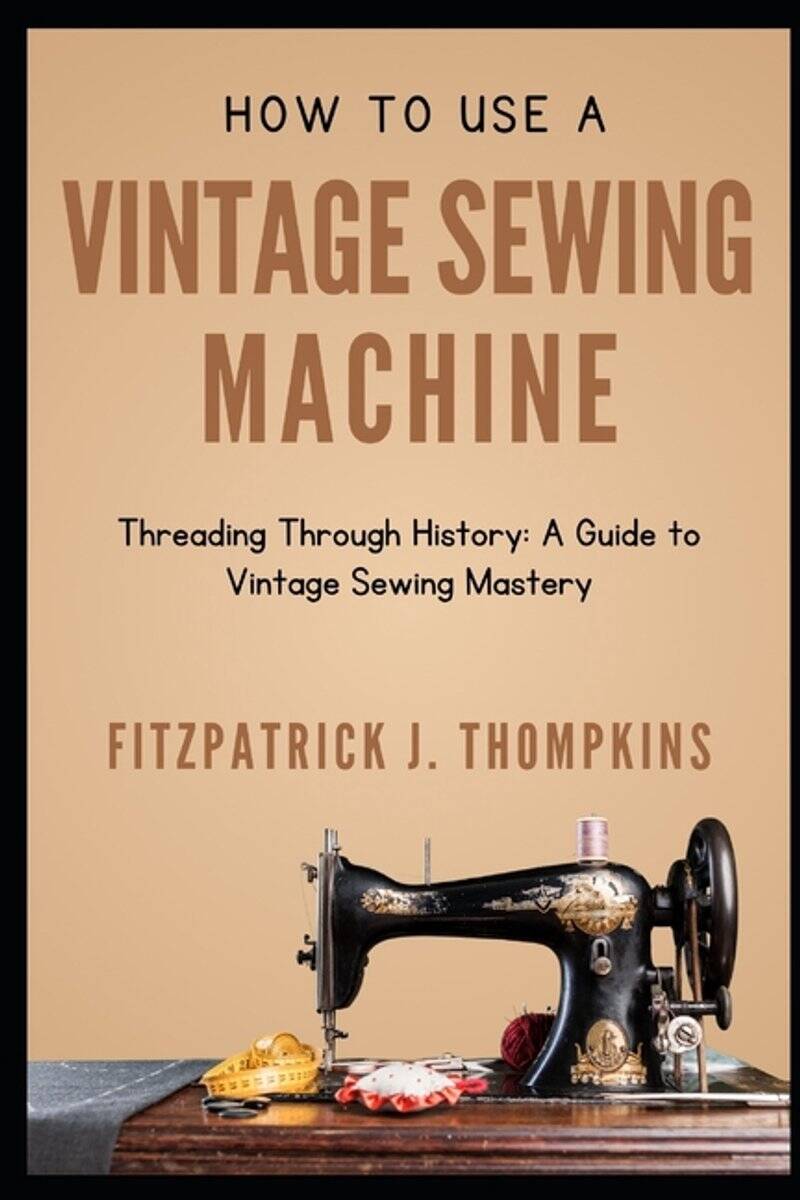
The Vintage Sewing Machine: Threading Through History: A Guide to Vintage Sewing Mastery is written and published by Fitzpatrick J. Thompkins.
So far, so good.
This is usually how I start a book review: the author, the publisher, the title and a little basic information about the book.
But this time, I have to admit that I immediately had some doubts.
Written by Fitzpatrick J. Thompkins?
I am not entirely convinced.
Perhaps it really is. But if so, I suspect that a text generator may have helped quite a lot along the way.
And that brings me to an interesting question: does it matter?
Why Did I Buy This Book?
As many of you probably know, I sew. A lot.
Seriously. I spend a large part of my time sewing historical costumes and home décor items for my two websites, Boekrecensiesblog and Handmade Luxury Home.
As a BERNINA Ambassador, I also have the pleasure of working with some very good modern sewing machines.
But in my atelier I also have two very old vintage sewing machines.
I originally bought them because I loved looking at them.
Yes, I know that sounds a little strange.
They are beautiful objects. Heavy cast-iron bodies, wonderful decorations and those wonderfully solid mechanical parts that seem to have been made to last forever.
Whether I can actually get both machines working again is another question!
This summer, I decided that I would finally make an attempt.
So when I found a book called How to Use the Vintage Sewing Machine, I thought:
Wonderful! This sounds as if it was written especially for me.
I ordered it.
And that is where my little adventure began.
Author or AI?
I think this is the first time I have read a book and thought: Was this written entirely by AI?
Of course, I do not know that.
Perhaps the author simply put his own knowledge into an AI program and asked it to turn everything into polished prose. Perhaps he used AI to rewrite the text several times.
There is nothing wrong with using modern tools when they help you communicate an idea.
But there is a difference between using AI as a writing assistant and using it to create the impression of expertise where there is very little new information.
And that is where I struggled with this book.
Knowledge or AI Knowledge?
The writing is often very enthusiastic. Sometimes almost too enthusiastic.
There are many beautiful and rather dramatic descriptions of vintage sewing machines. But when I started looking for practical information, I found very little that I did not already know.
The book starts with a short history of the sewing machine and then moves on to the advantages of owning a vintage machine.
There are chapters about getting to know your sewing machine, preparing it for use, starting to sew, cleaning and maintenance, a few simple projects and finally joining a community of vintage sewing machine enthusiasts.
All of these are perfectly sensible subjects.
But there is a problem.
There are no photographs, no illustrations and no diagrams to support the rather long explanations.
For a book about sewing machines, I find that a little disappointing.
A vintage sewing machine is a very visual object. There are knobs, levers, tension discs, bobbins, presser feet, needles and mechanisms. When you tell someone how to clean, oil or prepare a machine, a photograph or simple drawing can be worth far more than several paragraphs of text.
Instead, the book mainly explains logical things.
Clean your machine.
Learn what the different parts do.
Thread it correctly.
Take care of it.
Start with simple sewing.
Nothing is wrong with any of that.
But I kept thinking:
I already know this.
And if I know it, I suspect that many other experienced sewists will know it too.
A Bad Buy – Or Perhaps Not?
So now comes the difficult question.
Was buying this book a mistake?
I am not sure.
Because despite all my criticism, I actually enjoyed parts of it very much.
I loved the enthusiasm for old sewing machines.
There is something wonderful about these old machines. Their heavy iron bodies, beautiful decoration and beautifully engineered mechanical systems are fascinating.
Many of them were built at a time when manufacturers expected things to last for decades.
And they did.
Some of these machines are now more than a hundred years old and, with proper care, they can still sew beautifully.
That is something worth celebrating.
A vintage sewing machine is not just something pretty to put on a shelf.
It can still be a working tool.
And I think that is one of the most charming things about vintage sewing machines.
The Problem Is My Expectation
So perhaps the book is not a bad book.
Perhaps I simply expected something different.
I expected photographs.
I expected illustrations.
I expected practical information about different types of vintage machines, their mechanisms, common problems, troubleshooting and perhaps some information that would teach me something I did not already know.
Instead, I found a lot of general information written in very enthusiastic language.
For someone who knows very little about sewing machines, this book may actually be a pleasant introduction.
For someone who already sews and has some experience with sewing machines, I cannot really recommend it.
At least, not as a practical guide.
Vintage and AI
And you know what bothers me most?
I could probably have written this book myself.
With or without AI.
That is perhaps the strangest part of this whole experience.
The book made me think about how easy it has become to produce a beautifully written text. AI can create enthusiastic descriptions, long explanations and even a convincing sense of authority in just a few moments.
But writing beautifully is not the same as having something valuable to teach.
Especially when we are talking about traditional crafts.
Sewing machines, just like sewing techniques, have a history. They have details, quirks and practical knowledge that are often passed from one maker to another.
That kind of knowledge is difficult to replace with a beautifully written paragraph.
So, Fitzpatrick J. Thompkins, if you really wrote this book yourself: I admire your enthusiasm for vintage sewing machines.
If AI helped you write it: well, it certainly writes very enthusiastic prose!
But next time, please give us some photographs, some diagrams and a little more knowledge that we cannot find simply by asking a chatbot.
As for me, I am going back to my two old sewing machines.
They have been waiting patiently in my atelier for years.
Perhaps this summer I will finally get one of them running again.
And if I do, I promise you one thing:
I will take photographs. 😊

Add comment
Comments