There is something about the circus that stays with you.
When I was a child, I loved going to the circus. My parents were not particularly fond of it, but somehow, going to the circus was simply part of childhood. And in those days, the circus was quite different from what we see today.
I never saw an elephant riding a bicycle, or a tiger dancing with a hippopotamus wearing a little pink skirt. Thankfully, perhaps!
But I did see something I have never forgotten.
Once, a giraffe walked into the circus arena. She slowly bent her very long neck towards the audience and then gave us a little wink with those enormous, beautiful eyelashes.
I was fascinated.
And then there were the acrobats.
Oh, how I loved those incredibly flexible women flying through the air. They seemed almost weightless. They were strong, elegant and completely fearless.
They were also a huge inspiration to me.
For years, my friends and I spent countless hours practising gymnastics in the garden. We stretched, jumped, climbed and tried all sorts of things that probably made our parents rather nervous.
My greatest achievements?
A backward somersault.
And, rather proudly, a somersault over the greenhouse from a large springboard.
Looking back, I think that was quite impressive.
But of course, it was nothing compared with the real acrobats, who performed those movements high above the ground, often without anything resembling a sensible safety net!
A different view of the circus
Many years later, I took my own children to the circus.
This time, something was different.
Behind the circus tent there was an open area, and people could actually see what was happening behind the scenes. We could see the animals and talk to some of the people who worked with them.
It felt like a new kind of circus policy: more transparency, and allowing visitors to see the world behind the performance.
We soon found the horses.
I started talking to one of the horse handlers, and I was genuinely impressed by the care he gave his animals. He clearly knew his horses very well, and there was a lot of affection and attention in the way he looked after them.
A few weeks later, I wrote about this experience in a column for VrijRuiter, a Dutch equestrian magazine.
It was, as it turned out, almost the end of my career there.
I did not quite have bricks thrown through my windows, but I think some readers would happily have done so!
People were furious.
How could I write something positive about circus horses?
Did I know how hard these horses had to work? Did I understand how unnatural their tricks were? Wasn't it all simply about money and entertainment?
There were many strong opinions.
And, of course, they had a point.
Who has the better life?
The truth is that there are many ways of looking at this subject.
I sometimes see horses standing for years in a rather boring field, with very little to do and very little happening around them.
Then I think about the completely different life of a circus horse.
Training. Travelling. Performing. Meeting people. Living closely with its handlers and other animals.
Which horse has the better life?
I honestly don't know.
Perhaps nobody really does.
Animal welfare is complicated, and I certainly do not want to romanticise the old circus. Some things that were once considered normal would be completely unacceptable today, and rightly so.
But the circus itself remains fascinating to me.
Perhaps because it represents something that is disappearing: spectacle, craftsmanship, strange costumes, beautiful horses, painted scenery, music, lights and people who spend years learning one extraordinary skill.
And that brings me to circuscore.


What is Circuscore?
Circuscore is an aesthetic inspired by the visual world of the circus.
Think of ringmasters, clowns, jesters, acrobats, vintage circus posters, theatrical costumes, bold colours, decorative braid, ruffles, bells, top hats and slightly mysterious old-fashioned glamour.
It can be playful and colourful, but it can also be dark, elegant and almost gothic.
That is one of the things I particularly like about it.
You do not have to dress like a traditional clown to enjoy circuscore fashion. A beautifully fitted waistcoat, a dramatic jacket, a jester hat or a pair of theatrical trousers can be enough to create the feeling.
And, naturally, this is an aesthetic I understand very well.
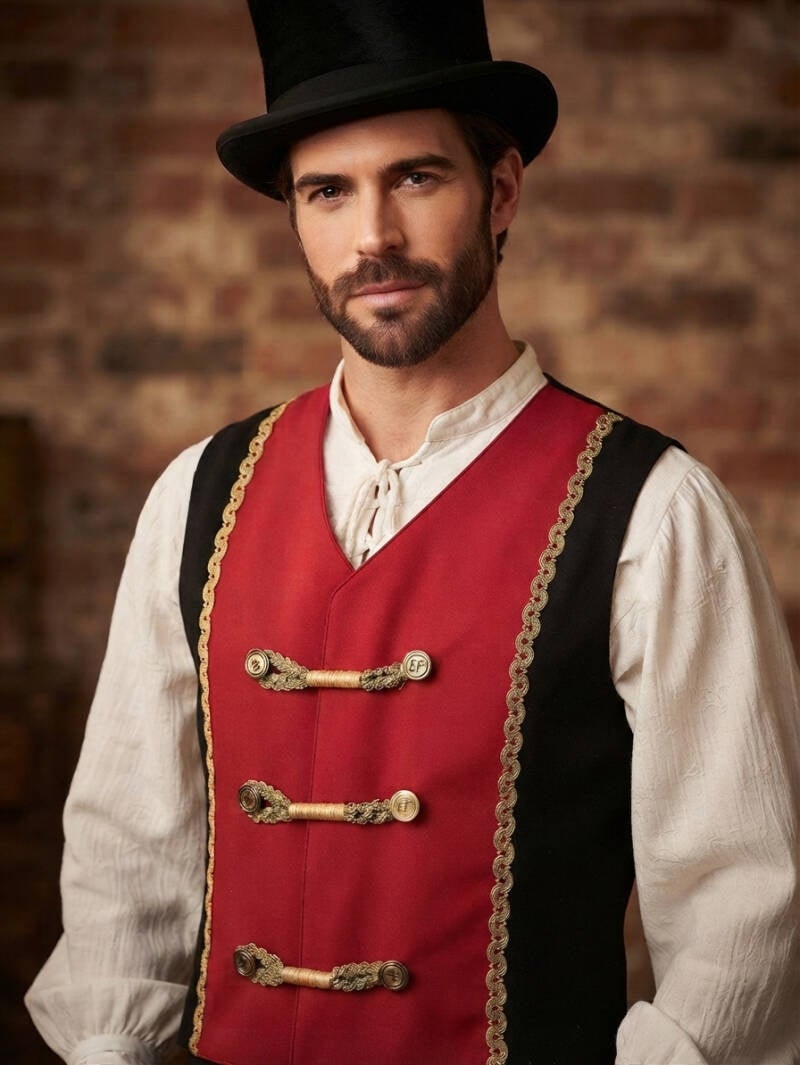
Over the years, I have made clowns, jester hats, ruffs, circus-inspired costumes and ringmaster-style outfits. This red and black waistcoat is another example.
The combination of deep red, black fabric, gold braid and decorative closures gives it that wonderful theatrical feeling.
It could belong to a circus director, a ringmaster, a magician, a fantasy character or perhaps someone who has just stepped out of an old circus poster.
And that is exactly what I enjoy about costume making.
A costume does not have to tell you exactly who you are.
Sometimes it simply gives you permission to become somebody else for a while.
Behind this costume
When I made this red and black circuscore waistcoat, I was not thinking only about fashion.
I was thinking about those circus tents from my childhood.
The strange and wonderful animals.
The acrobats.
The music.
The enormous costumes.
And that giraffe who slowly walked into the arena, bent her long neck towards us and gave us a wink.
Perhaps that is why circus-inspired clothing still feels so familiar to me.
It is not only a fashion trend.
For me, it is connected to memories.
And perhaps that is the real magic of costume making: sometimes, years later, a piece of fabric, a colour or a particular shape can take you straight back to another time.
Circuscore may be a modern fashion trend, but for me, the circus has been part of my imagination since childhood.
And apparently, I am still not quite finished with it.
Would you like your own circus-inspired costume?
I love creating costumes with a story behind them.
If you are looking for a circuscore costume, ringmaster outfit, jester costume, theatrical waistcoat or a completely original fantasy costume, I am happy to discuss a commission.
Every costume is made in my small atelier and can be designed around your character, measurements and ideas.
After all, the best costumes are not simply clothes.
They are the beginning of a story.
-
Last one!

-
Sale!

-
 Custom Giant Jester Hat Long Wings Cosplay €295.00 FREE shipping


One of a Kind Velvet Jester Hat Four Wing Court Jester

Luxury Four Wing Jester Hat – One of a Kind Wearable Art
A truly exceptional jester hat for those who appreciate craftsmanship, historical inspiration and theatrical elegance.
This handmade four-wing jester hat is a unique, one-of-a-kind creation featuring four individually designed wings, each crafted from a different luxurious velvet fabric or pattern. The rich combination of colours, textures and materials creates a striking visual effect that cannot be replicated.
Filled for volume and shape, the hat drapes beautifully while maintaining its dramatic silhouette. Large antique-style copper bells add movement, sound and authenticity, while two matching fabric brooches provide additional decorative detail.
Inspired by the elegance of noble court jesters, this piece bridges the worlds of Medieval, Renaissance, Baroque and Art Nouveau design.
Features
✦ One of a kind
✦ Handmade
✦ Four-wing design
✦ Four different luxury fabrics
✦ Velvet construction
✦ Filled for volume and shape
✦ Large copper bells
✦ Two matching fabric brooches included
✦ Lightweight and comfortable to wear
Perfect For
- Medieval Festivals
- Renaissance Faires
- Historical Fantasy Events
- Court Jester Costumes
- Fantasy Photography
- Cosplay Competitions
- Stage Performances
- LARP Events
- Baroque Styling
- Art Nouveau Inspired Fashion
- Collectors of Wearable Art
A Unique Creation
Unlike mass-produced costume accessories, this jester hat was created as an individual work of textile art.
The combination of luxurious fabrics, dramatic proportions and handcrafted details makes it suitable for collectors, performers and costume enthusiasts seeking something truly special.
No second identical version exists.
Handmade by Historique Couture.
Add comment
Comments