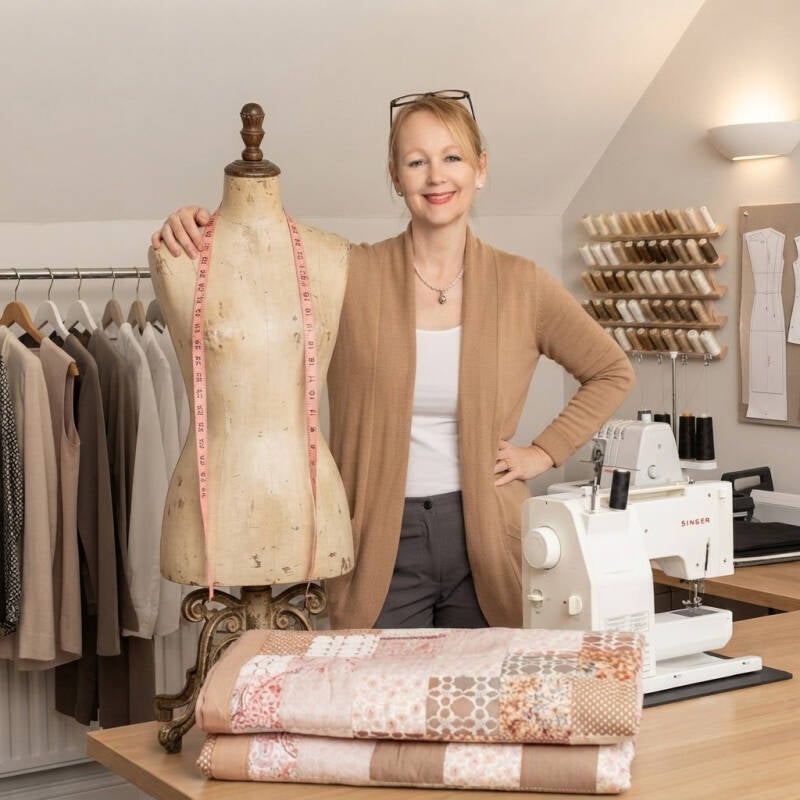
When you commission or buy a costume from Historique Couture, there is something I want you to know from the very beginning:
Your costume is made here in Europe, personally by me.
Not in a factory on the other side of the world. Not outsourced to another workshop. Not ordered from a manufacturer and shipped directly to you.
It is made in my small atelier in the Netherlands.
That is important to me.
A European costume atelier
Historique Couture is a small, personal atelier. I design, draft, cut, sew, fit and finish the costumes myself.
This is particularly important with custom cosplay commissions. A costume may look simple in a reference image, but turning that image into a real garment requires decisions about proportion, fabric, construction, movement and fit.
When you commission a costume from me, you are commissioning the work of a person, not a production line.
That also means that every costume is slightly different. I do not have a warehouse full of identical costumes waiting to be shipped. I make each commission for one particular person and one particular project.
Why Europe?
I live and work in the Netherlands, and most of my clients are in Europe.
There is something very practical about keeping production close to home.
I can buy materials from European suppliers, visit fabric shops and markets, look for suitable buttons and other haberdashery, and sometimes find exactly the little detail I need in an unexpected place.
Whenever possible, I buy fabrics locally.
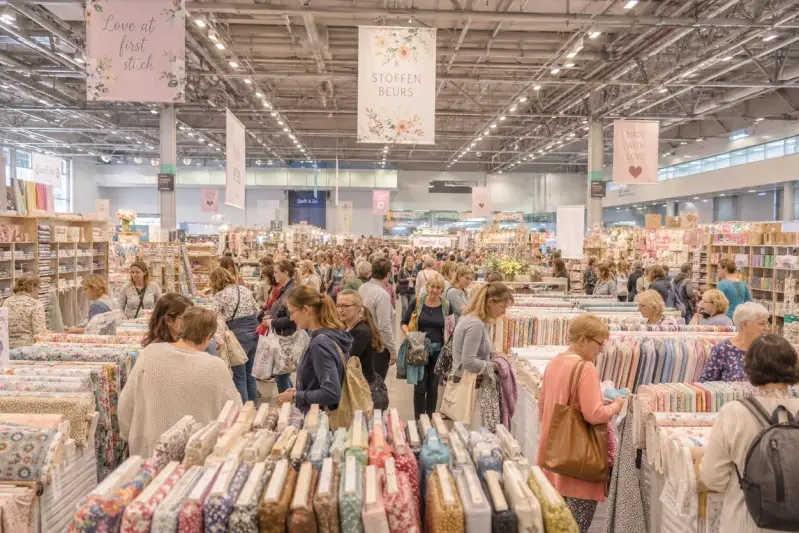
I visit fabric markets and the few physical fabric shops that are still available. I also buy online, but I keep my online sourcing deliberately close to home: mainly Dutch fabric shops, one supplier in Belgium and, occasionally, a fabric shop in Germany.
Of course, I cannot claim that every metre of fabric sold by a European shop was woven or produced in Europe. The textile industry is international, and tracing every stage of production is not always possible.
But I can tell you where I buy it.
And I can tell you where your costume is made.
In my atelier in the Netherlands.
I sometimes find materials in unusual places
For me, sourcing materials is part of the craft.
Buttons, trims, buckles and other findings can come from fabric shops, markets, specialist suppliers and sometimes second-hand sources.
I even look on Dutch marketplaces and visit charity and thrift shops when I am searching for something useful.
But there is an important distinction.
If I buy fabric from a second-hand shop, I am very particular about what I will use. I am not going to put a previously used piece of household fabric into a couture or cosplay commission simply because it is cheap.
If I find fabric in a charity shop, it would generally be something such as a curtain that is still in its original packaging.
I am looking for the material, not somebody else's old living-room smell!
Nicotine, damp, mould and that unmistakable smell of an old house have no place in my atelier.
Small-scale also means thoughtful sourcing
There is a certain freedom in being a very small business.
I do not need to order thousands of metres of fabric.
I do not need thousands of boxes printed with my logo.
I do not need enormous quantities of packaging materials sitting in a warehouse.
I buy what I need for the work I am actually doing.
Sometimes that means buying a beautiful piece of fabric because it is exactly right for one particular costume.
Sometimes it means searching for an old-fashioned button at a market.
Sometimes it means finding a suitable box at the local supermarket instead of ordering a pile of brand-new shipping boxes.
That may not look glamorous.
But it makes sense to me.
Even the packaging is small-scale
When I send a finished costume to a client, I need packaging that protects the work during its journey.
I often reuse sturdy boxes that I can obtain locally rather than buying large quantities of brand-new boxes.
For tape, I prefer paper tape where practical.
The shipping label is printed, attached, and the package is ready to go.
If the weather is particularly wet, I may add an extra layer of plastic protection around the package. When I do, I prefer biodegradable options where suitable.
It is not a perfect zero-waste system. I would never claim that it is.
It is simply the practical system of a small atelier trying to avoid unnecessary waste while making sure that an expensive handmade costume arrives safely.
No mass production. No outsourcing.
There is another reason I emphasise where Historique Couture is based.
There is a great difference between buying a handmade-looking costume online and commissioning a costume from a person who actually makes it.
A photograph can make those two things look surprisingly similar.
The production process is not.
At Historique Couture, I do not send your measurements to another workshop.
I do not outsource the sewing.
I do not order a finished costume from a manufacturer.
I do not operate a dropshipping model.
I make the costume myself.
That is the promise behind the name Historique Couture.
From the Netherlands to the rest of Europe
Being European-made does not mean that I only work with clients who live around the corner.
A custom costume can travel.
I have received enquiries from outside the Netherlands, including from the United Kingdom and the United States. I am happy when someone from further away discovers my work.
But the costume itself does not travel around the world during its production.
The work starts here.
The pattern is made here.
The fabric is cut here.
The costume is sewn here.
The fittings and adjustments are handled here.
And the finished costume leaves my Dutch atelier to begin its journey to its new owner.
Made in Europe. Made by Marga.
There is a simple reason I want to say this so clearly.
When you commission a custom cosplay or historical costume, you are not simply buying an object.
You are commissioning time, knowledge, research, pattern making, sewing, fitting and finishing.
You are also choosing who makes it.
For me, that matters.
So if you commission a costume from Historique Couture, you can expect something very straightforward:
Made in Europe.
Made in the Netherlands.
Made personally by Marga.
No mass production.
No dropshipping.
No anonymous factory or brand.
Just one costume maker, one atelier and one costume at a time.
Read more about fabric markets:
Read more about the disappearance of Fabric & Haberdashery stores:

Add comment
Comments