Reflections on Fashion – When Does a Dress Become a Museum Piece?
9 August 2026
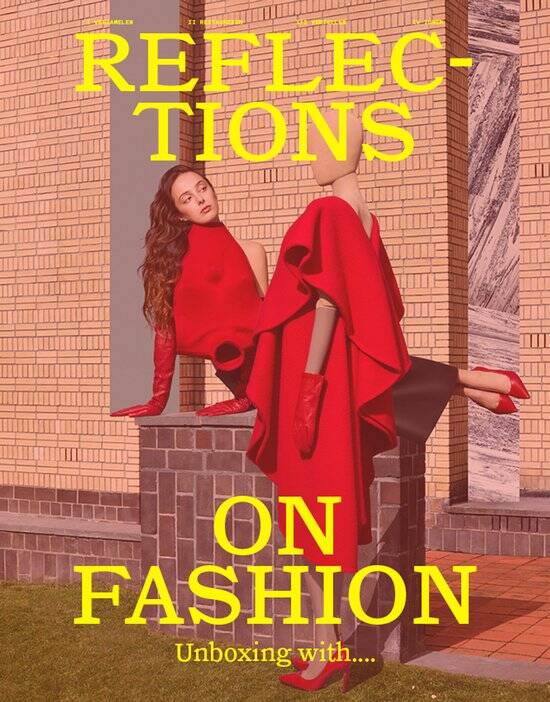
Reflections on Fashion is published by Waanders Publishers in collaboration with Artmuseum Den Haag.
The book also includes contributions from Madelief Hohé, Margriet Schavemaker, Marije Blaase, Micaela Cabrita da Palma, Tirza Westland, Alu Studios, Janice Deul, Ronald van der Kamp, KledingCast, Cyana Madsen, Amy de la Haye, Valerie Steele, Kathleen Mahieu, Jacoba de Jonge, Lisa Konno, Bas Kosters, Guillaume Schmidt, Victor Crezee, Tailors & Wears, Jan Taminiau, César Rodríguez Salinas, Sarah Scaturro, Ulkuhanbatuhan, Tess van Zalinge and Karolina Żebrowska.
On the back of the book there is an impressive list of designers, ranging from the seventeenth century right up to the present day.
Artmuseum Den Haag
In 2026, Kunstmuseum Den Haag celebrates 75 years of its fashion collection. What started in 1951 as the Dutch Costume Museum has grown into the largest fashion and costume collection in the Netherlands.
The collection contains more than 50,000 costumes and accessories, ranging from seventeenth-century clothing to very recent pieces from the catwalk.
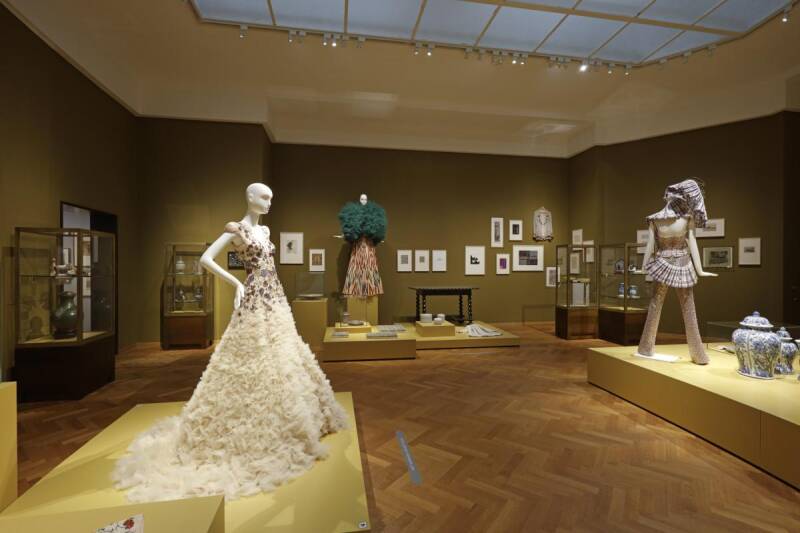
The exhibition Reflections on Fashion runs from 4 July 2026 until 3 January 2027. It offers a broad look at the way fashion has developed over time. The garments on display show how styles, shapes and ideas have changed throughout the centuries.
Reflections on Fashion – Dutch edition
When Does a Dress Become a Museum Piece?
I have a soft spot for clothing that has something to say.
Not only a beautiful dress that makes you think, what a wonderful piece, but especially clothing where you can see that somebody once lived in it. A hem that was once let down. A repair that is almost invisible. A fabric that has become softer through years of wear.
Clothing tells stories. Sometimes much more than we realise at first.
And that kind of history is something I also enjoy creating myself.
Museum & Heritage Clothing Commissions
This blog is mainly about the book. If you are unable to visit the exhibition, the book is also available through various booksellers. And honestly, even without seeing the exhibition, it is an impressive book in its own right.
A Book That Makes You Look at Fashion Differently
The title Reflections on Fashion is very well chosen.
This is not simply a book about 75 years of collecting fashion. It is about looking, looking again, and asking who decides what is important enough to preserve.
The book is divided into four sections: collecting, restoring, telling and displaying. You can read these sections separately, but they also connect beautifully.
The collection of Artmuseum Den Haag began in 1951 as the collection of the Dutch Costume Museum and grew into an extraordinary collection of more than 50,000 costumes and accessories, from historical clothing to contemporary fashion.
When you read that number, it may sound impressive, but also rather abstract. While turning the pages of this book, however, the collection suddenly feels very different.
It is no longer thousands of objects stored somewhere in a museum depot. Instead, you begin to see individual garments, each with its own history.
And then you realise something rather fascinating.
A piece of clothing that was once completely ordinary can become a museum piece decades later.
What was contemporary in 1951 is now history.
There Is Not Just One Story About a Dress
The collection is not presented from one single point of view.
The Unboxing part of the exhibition is an important starting point. Different designers, makers and fashion experts were invited to look at the collection again and to approach it from their own perspective.
I think this idea works particularly well in the book.
Together with the beautiful photography and carefully designed layout, it makes Reflections on Fashion a wonderful coffee-table book. It is full of valuable information and interesting stories, but above all, it contains many beautiful photographs.
My only personal criticism is the size of the text. Or perhaps I should say the smallness of the text! It is not always easy to read.
Fortunately, there is plenty of white space, different typefaces and clear paragraph layouts, so you do not easily lose your place.
There are also many pages that are almost entirely devoted to photographs and captions. The use of colour is beautiful, and I particularly like the loose cover of the book. It can be unfolded and displayed, or even framed.
I noticed the same idea in another book I reviewed, U bent hier, Kunst in Amsterdam. Perhaps this is becoming a new trend? I rather like it.
Clothing with a Story
A curator looks at a garment differently from a designer.
A restorer looks closely at the materials and construction. Someone working with contemporary fashion may see an idea that suddenly feels surprisingly modern.
This creates a very interesting way of looking at historical clothing. There is no single story that tells you exactly what a garment means. Instead, the reader is given different ways of looking at it.
And I think that is one of the strengths of this book.
From the Seventeenth Century to Today
A fashion collection such as the one at Kunstmuseum Den Haag is really a kind of time machine.
In Reflections on Fashion, different centuries and styles come together. This allows you to see not only how fashion changes, but also how our ideas about the body, beauty, status and identity have changed.
The photographs are especially important here.
A photograph of a dress can show you its silhouette, but when you then read about the material, the construction or the circumstances in which the garment was worn, the image suddenly gains another layer.
That is what makes historical clothing so fascinating to me.
The Story Behind the Restoration
One of the stories that stayed with me is that of a Chanel dress from 1926.
As some of you probably know, I am a great admirer of Coco Chanel. I even have a website for dressmakers with tips and techniques for anyone who would like to make a Chanel-style jacket.
But back to the dress.
The garment was found among fabric remnants and was missing thousands of beads. Restorer César Rodríguez Salinas reconstructed the pattern.
However, the aim was not to restore the dress so perfectly that you could no longer see what had happened to it.
Instead, the difference between the original material and the restoration remains visible.
I love this approach.
A historical garment is allowed to keep the marks of its own history.
It was worn by someone. It was not originally made to sit inside a glass museum case.
That distinction is important to me as a costume maker. I love seeing signs of use and repair because they remind us that clothing was once part of everyday life. Someone chose to wear it. Someone moved in it, worked in it, danced in it or simply lived in it.
That is part of its story.
The Book as an Object
Reflections on Fashion is a large, colourful and richly illustrated book of 240 pages.
The generous format gives the garments the space they deserve. Fashion is three-dimensional, after all. A small photograph can never completely show the way a fabric falls, how a silhouette is constructed or how delicate a particular detail really is.
For anyone interested in fashion, costume and history, this book is a valuable addition to the bookshelf.
Or, of course, to the coffee table!
And now I am going back to making costumes.
Perhaps one day some of the costumes I make will end up in a museum too.
And maybe, just maybe, they will one day appear in one of those beautiful Waanders books.
One can always dream. 😊

Add comment
Comments