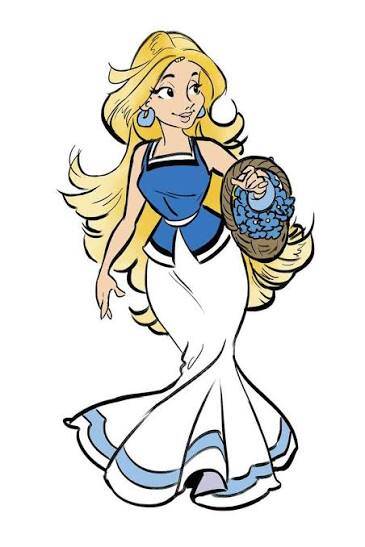

Yes, it can.
In my atelier, I often work from pictures rather than from sewing patterns. A cosplay client may send me a screenshot from a film or game, character artwork, concept art, or even just one good photograph of the character.
Sometimes, that is all I have to start with.
But making a costume from a picture is not as simple as copying what you see.
A picture shows you the finished character. It does not show you how the costume was made.
And that is where the real work begins.
I learned to look at pictures
I have learned to look very carefully at pictures.
Actually, I think I started doing this as a child.
My sister and I would look at pictures of princesses, fairies, and characters from children's books. We even saw a picture of a woman in an Asterix & Obelix costume. We tried to draw the clothes ourselves.
Later, we started trying to make them.
First with simple crafts, and later with a sewing machine.
At the time, I never thought this would become part of my work.
Many years later, it suddenly came back.
“Mom, can you make this for me? For Comic-Con?”
And there it was again.
A picture.
Sometimes nothing more than a drawing.
But by then, I had many years of experience with fabrics, sewing and making clothes. I had learned how to look at a picture and start asking the right questions.
What fabric could I use?
Could I use an existing sewing pattern?
Do I need to change a pattern?
Or do I need to make the pattern myself?
How is this part actually constructed?
How can I make it look like the picture, but still make it into a real garment?
That is where the work begins.
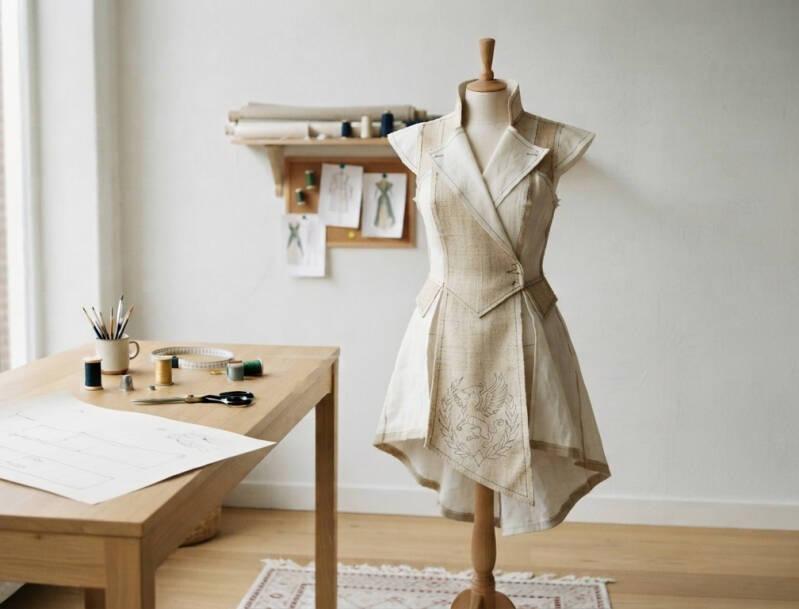
A picture is only the beginning
When a client sends me a character image, I look at the costume very carefully.
Where are the seams?
How does the garment open?
Where does the fabric change?
How is the collar constructed?
Is the sleeve one piece, or does it have several parts?
Is there stiffening inside?
How does the garment fit around the body?
These are details that are often impossible to see in the original image.
A character may look perfect on screen, but a real person has to move, sit, walk and breathe in the costume.
That changes everything.
A character exists in two dimensions
One of the most important things to understand about custom cosplay is this:
A character exists in two dimensions. A costume has to work in three.
A drawing can show a beautiful shape without explaining how that shape is created.
A digital character can have a perfect waist, very sharp shoulders or an unusual sleeve shape. On a real body, those shapes need fabric, seams, structure and sometimes interfacing or other support.
As a costume maker, I have to work out how to turn the visual idea into something that can actually be sewn and worn.
This is a little like solving a puzzle.
It takes patience
Sometimes I know almost immediately how I want to make something.
Sometimes I don't.
There can be a lot of testing and trying.
I may make something in inexpensive fabric first to see if the shape works. I may change a pattern several times. I may try a different construction method.
And yes, sometimes I use ChatGPT to help me think through a difficult construction problem or find another way of approaching something.
But the final decision still has to work with the fabric, the body and the costume.
A computer can help me think.
It cannot replace the work at the sewing table.
Sometimes the answer only comes when I actually make the thing and see what happens.
The costume has to be wearable
There is another very important difference between a character image and a real cosplay costume.
The character does not have to spend an entire weekend at Comic-Con.
My client might.
So the costume cannot only look good.
It also needs to be wearable.
Can you walk in it?
Can you sit down?
Can you move your arms?
Will you be too hot?
Will the fabric make you sweat?
Will you be cold?
Can you wear it for several hours?
And then there are the shoes.
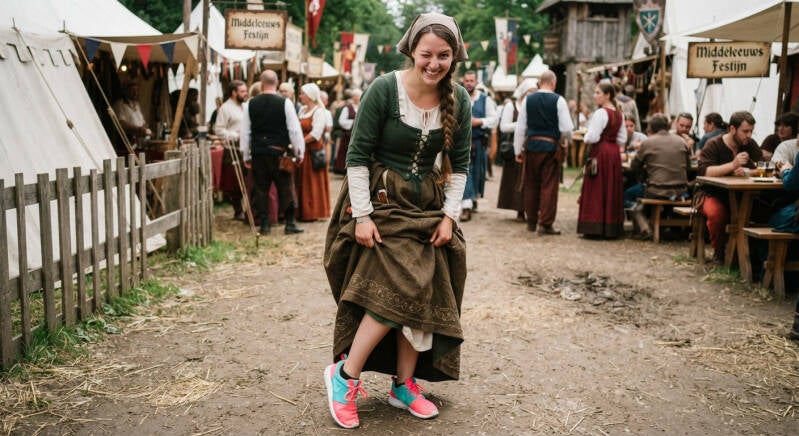
Sometimes the character appears to wear beautiful boots or complicated shoes. But perhaps my client needs to walk around all day.
So I might ask: how can we hide this?
Can we make the costume cover a comfortable pair of trainers?
If we can, my client can walk around Comic-Con in sneakers while still looking like the character.
Those little practical decisions are part of making a good cosplay costume.
One picture is not always enough
Sometimes a client has several reference images.
That is wonderful.
A front view can tell me one thing. A side view can reveal something completely different. A picture from the back may show seams, closures or details that cannot be seen from the front.
I often like to see as many useful reference images as possible.
They do not all have to be beautiful promotional pictures. Screenshots can be extremely useful too.
Even a small detail in the background can answer an important question about how a costume is constructed.
Of course, sometimes there is only one image.
That is not necessarily a problem.
It simply means that I have to use my experience to make informed decisions about the parts that cannot be seen.
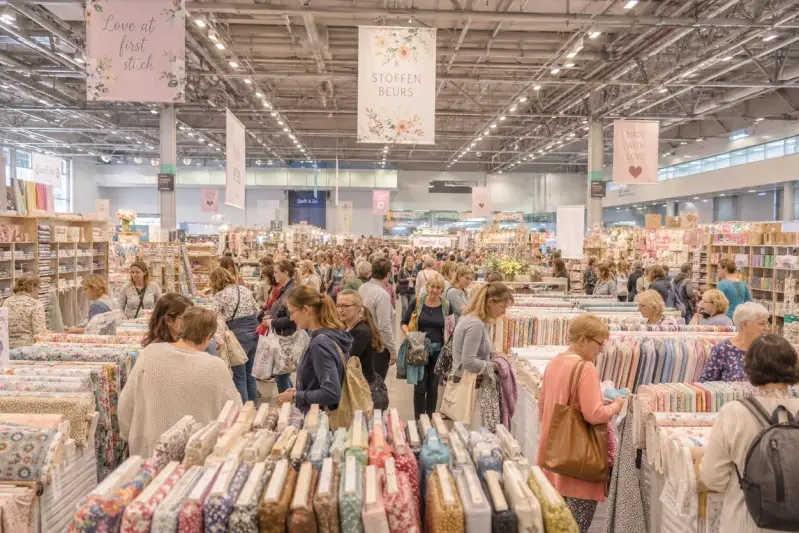
The fabric matters
A picture may make a costume look as if it is made from one particular material, but photographs and digital artwork can be misleading.
A fabric may look heavy when it is actually light.
A shiny material may look like satin, but could have a completely different structure.
A skirt may appear stiff because of the way the character is standing, while the real garment needs layers, interfacing or another form of support to create the same effect.
This is why I do not simply choose a fabric because it “looks right” in a picture.
I also ask:
How should it fall?
How should it move?
Does it need structure?
Will it be comfortable to wear?
Will it hold the shape of the original design?
The right fabric can make a huge difference to the final result.
The human body changes the design
A character may have been designed with perfect proportions that do not exist on a real person.
That is perfectly normal.
When I make a custom cosplay costume, I have to translate the costume to the measurements and shape of the person who will wear it.
This can mean changing the position of seams, adjusting proportions, reshaping sleeves or modifying the construction of a garment.
The goal is not simply to make a smaller or larger version of the picture.
The goal is to make the costume look right on the person wearing it.
That is one of the biggest differences between a custom-made costume and a costume made from a standard size.

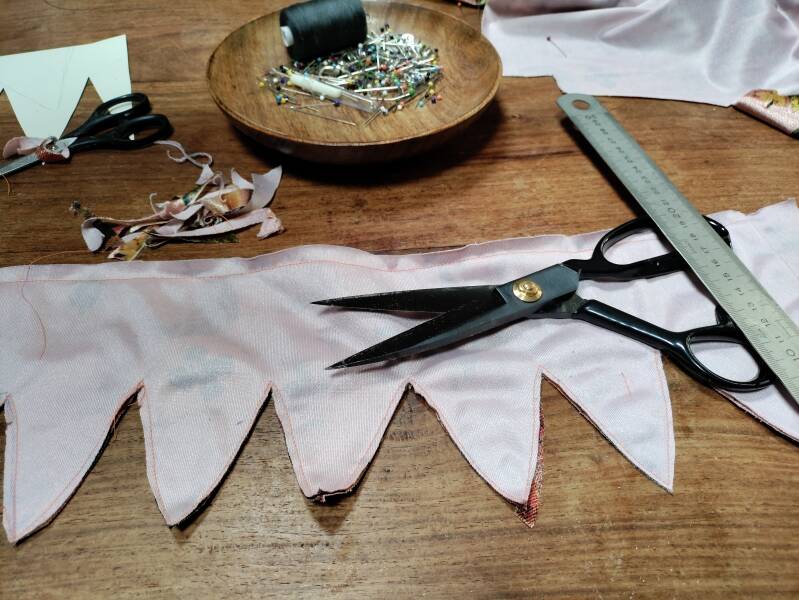
Sometimes I have to become a costume detective
I actually enjoy this part of the work.
When I look at a character reference, I am not only looking at the colours and decorations.
I am asking myself:
How would I make this?
Perhaps a strange-looking collar is actually made from several layers.
Perhaps a beautiful sleeve needs a particular sleeve head to create its shape.
Perhaps a fitted jacket needs carefully placed seams that are almost invisible in the reference image.
Perhaps the character's costume looks simple, but the construction is surprisingly complicated.
This is where years of sewing experience become important.
You learn to look at a garment and see the construction behind it.
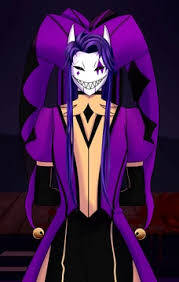
What if the character only exists in artwork?
That is also possible.
In fact, some of the most interesting cosplay commissions start with concept art or an illustration.
With artwork, there may be even more interpretation involved.
A drawing does not always follow the rules of real clothing. A designer may create a dramatic collar, enormous sleeves or a very unusual silhouette simply because it looks good.
My job is to keep that visual character while finding a practical way to construct it.
Sometimes that means adapting the original design slightly.
The costume still needs to look like the character.
But it also needs to be a real garment.
Good reference images help
If you are thinking about commissioning a custom cosplay costume, good reference images are very helpful.
You do not need a professional photoshoot.
Screenshots, artwork, photographs and images from different angles can all be useful.
If you have close-ups of details, those are especially valuable.
And if you have several versions of the costume, send those too. Sometimes one image answers a question that another image creates.
There is no need to understand sewing terminology.
That is my job.
You bring the character and the visual references.
I work out how to turn them into a real costume.
From character to costume
This is what I love about custom cosplay.
The process starts with an image.
Then come the questions, the measurements, the fabric choices, the pattern making and the sewing.
There is patience involved.
There is practice.
There is sometimes a little frustration.
There is a lot of testing.
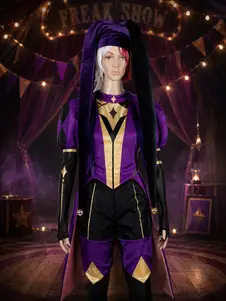
And then, slowly, something that only existed on a screen or on paper becomes a real garment.
Something you can put on.
Something you can move in.
Something made especially for you.
That is why I never see a reference picture as just a picture.
To me, it is the beginning of a design and construction problem.
And solving that problem is one of the most rewarding parts of being a costume maker.
A character exists in two dimensions. A costume has to work in three.
That is the difference between copying an image and creating a costume.
Add comment
Comments