Organza Fabric for Cosplay: Magic, Movement and Sewing Frustration
Do you want to make a beautiful fantasy costume, a magical cape, or a skirt that moves with every step? Organza might be the fabric you need! But be warned: this beautiful material can also test your patience.
As a costume maker, I love fabrics that bring a design to life. And organza is one of them.
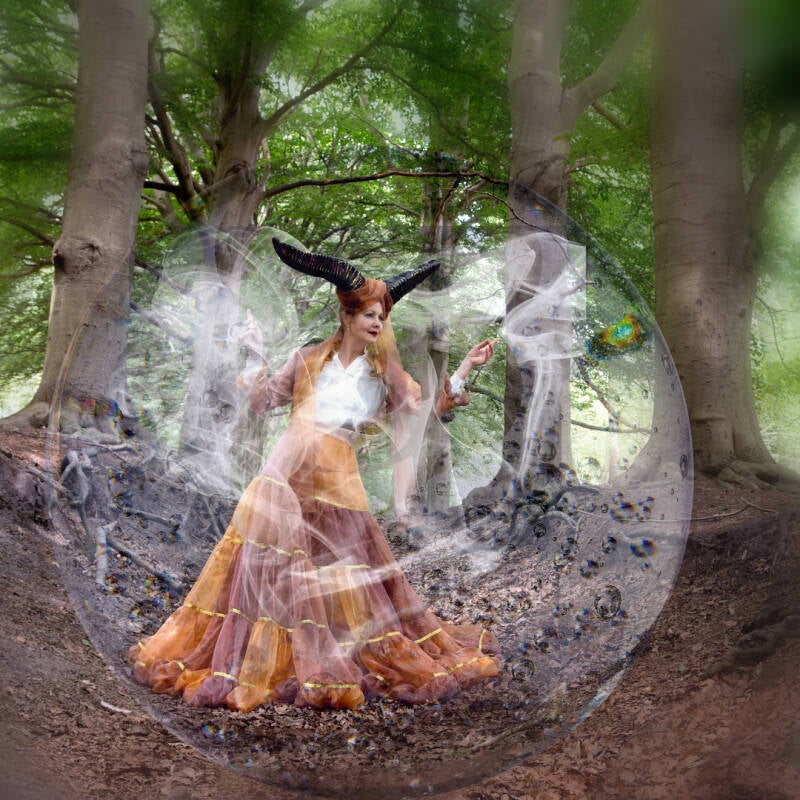
It can look delicate, elegant, mysterious, and almost magical. It catches the light, creates beautiful layers, and moves beautifully when you walk, dance, or pose for photographs.
But there is another side to this story.
Organza can slip under your sewing machine foot, refuse to stay in place, and make you wonder why you ever started this project!
So, let's take a closer look at organza fabric and discover why it is such an interesting material for cosplay and fantasy costumes.
What Is Organza Fabric?
Organza is a thin, lightweight, transparent fabric with a relatively crisp structure. It is usually made from polyester, nylon, or silk.
Each type has its own qualities.
Synthetic organza is often affordable and comes in many colours. It can be an excellent choice for cosplay costumes, especially when you need several metres of fabric.
Silk organza is a beautiful luxury fabric. It has a special softness and elegance and is often used in high-end fashion and couture.
Some organza fabrics have two different colours in their threads. This creates a wonderful two-tone effect. The fabric appears to change colour when you move it or when the light falls on it from another direction.
I particularly love this effect for fantasy costumes.
One moment, the fabric looks blue. A second later, it catches the light and becomes purple or green.
No extra decoration is needed. The fabric does the work for you!
Why Is Organza So Interesting for Cosplay?
Cosplay costumes often have to do more than look beautiful on a hanger. They must also look good when you move, walk, pose, and take photographs.
Organza can help you achieve this.
Because the fabric is lightweight and transparent, you can use several layers without adding as much weight as you would with many heavier fabrics.
You can use organza to create:
-
Flowing fantasy capes.
-
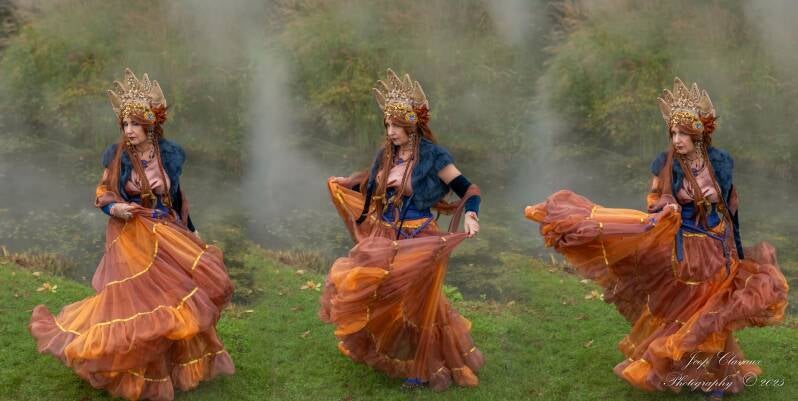
Wide skirts with beautiful movement.
-
Magical dresses with transparent outer layers.
-
Fairy wings and fantasy-inspired details.
-
Ruffles, sleeves, and decorative panels.
-
Elegant overlays for historical or fantasy costumes.
-
Dramatic effects for stage costumes and photoshoots.
Organza can also give a costume more depth.
Imagine a dark blue dress with a layer of blue and purple two-tone organza. When the wearer turns, the colours change with the movement.
Or imagine a red costume with a transparent black organza overlay. The black layer changes the appearance of the red fabric and creates a darker, more mysterious look.
These are simple ways to make a costume more interesting without adding lots of heavy decorations.
And there is another advantage: organza can look spectacular in photographs. The transparent layers catch the light, while the movement of the fabric creates a sense of drama.
For fantasy cosplay, this is a wonderful combination.
Organza or Tulle: Which One Should You Choose?
Organza and tulle are sometimes used for similar projects, but they are not the same.
Tulle is a net-like fabric with an open structure. Depending on its type and stiffness, it can create volume, from soft and airy layers to a very full skirt.
Organza has a woven structure. It is transparent, but its surface is smooth rather than net-like. Many types have enough body to hold a shape while still allowing movement.
Which fabric is best depends on the effect you want.
Choose tulle when you want:
-
Lots of volume in a skirt.
-
A fluffy or airy appearance.
-
A net-like texture.
-
Several layers that create fullness.
Choose organza when you want:
-
Transparent layers with a smooth surface.
-
A more structured, elegant appearance.
-
Beautiful reflections and colour effects.
-
A cape or skirt that moves in a graceful way.
You can also combine the two fabrics.
For example, tulle can help create volume underneath a skirt, while organza adds a beautiful outer layer.
There is no single correct answer. As a costume maker, you have to think about the final design, the movement of the garment, and the effect you want to achieve.
And, of course, your budget matters too!
My Columbina Project: Creating a Flowing Cape
Recently, I worked on a costume project called Columbina.
The starting point was an AI-generated image of a beautiful fantasy costume. My client asked me to turn the design into a real garment.
The image was stunning, but there was one small problem.
It was impossible to make exactly as shown!
The design did not explain how the different pieces were connected, and the way the fabrics behaved was not realistic.
So I had to rethink the design and find a practical solution.
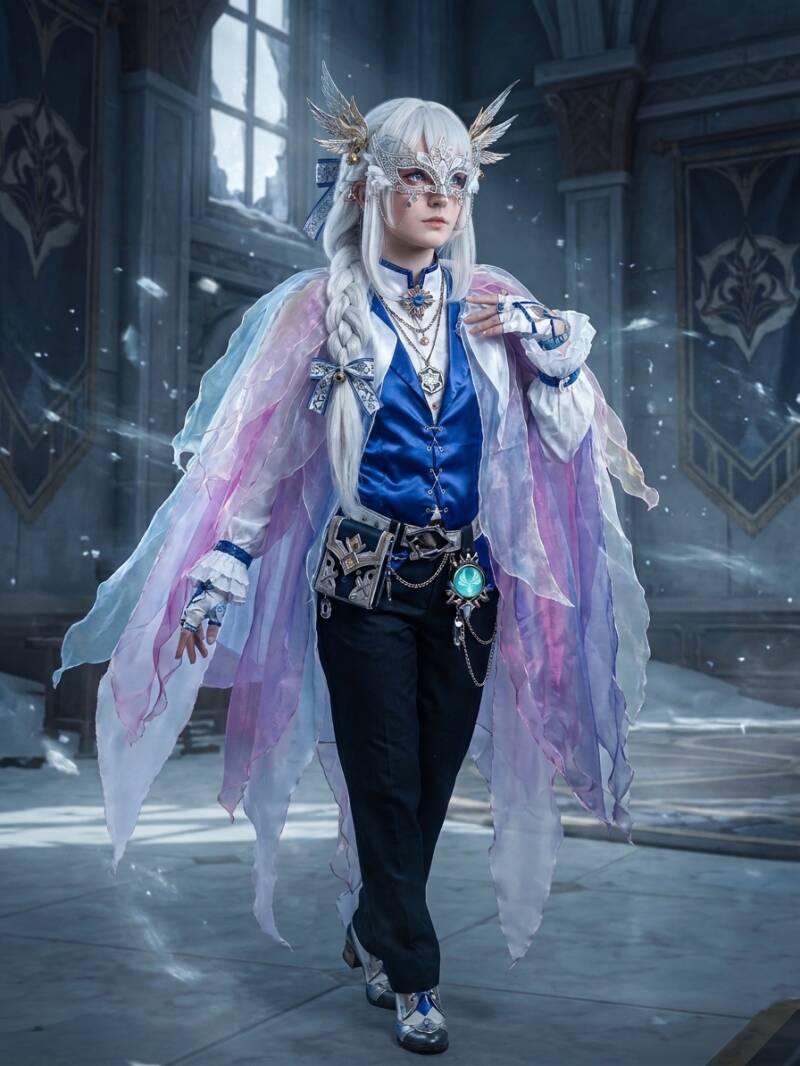
I proposed making the blouse, a fitted blue vest, and a flowing cape. The other elements would be added separately.
The cape was particularly interesting because I wanted it to move beautifully.
My choice was two-tone organza combined with Korean silk.
The organza provided the transparent layers and changing colours. The Korean silk added shine and a luxurious appearance.
Together, they created the effect I wanted.
But then came the difficult part.
The cape needed a golden edge.
Every strip of organza had to be carefully finished with gold-coloured thread. This required many hours of work, and I quickly discovered that the correct overlocker settings were essential.
The fabric had to be held properly throughout the process.
Walking away to make a cup of coffee while the overlocker continued working was definitely not an option!
A few days later, I almost felt as if I had grown wings myself. There was organza everywhere.
But the result was worth the effort.
After a month of work, the basic Columbina costume was ready. The cape, blouse, and bright blue vest were finished, and the next stage was in the hands of my client.
This project reminded me of something important.
Choosing the right fabric is not only about colour or appearance. It is also about understanding how a fabric behaves and what you can realistically achieve with it.
That is where the experience of a costume maker makes a difference.
Sewing Organza: Why Can It Be So Difficult?
Organza looks delicate because it is delicate. Some types are easier to sew than others, but the lightweight fabric can present several challenges.
The fabric may slip while you are cutting it. It can move under the presser foot, and small mistakes can be difficult to hide because the fabric is transparent.
Finishing the edges can also take time.
Here are some practical tips from the sewing room.
1. Cut Carefully
Organza can slide across the cutting table, especially when you are working with several layers.
Use a large, flat surface and make sure the fabric is smooth before cutting.
Pattern weights can help keep the fabric in place. Fine pins can also be useful, provided they do not damage the material.
For important costume pieces, consider cutting single layers instead of folding the fabric in half. It takes longer, but it gives you more control.
Sharp fabric scissors or a suitable rotary cutter can help you achieve clean edges.
2. Choose the Right Needle
A fine, sharp sewing machine needle is usually a good starting point.
For lightweight organza, a fine Microtex needle may work well. The correct size depends on the fabric and the thread you are using.
Always test your needle on a small piece of the actual fabric before starting the costume.
If the needle leaves visible holes or pulls the threads, try a different size.
A little preparation can save you a lot of frustration later.
3. Adjust Your Sewing Machine
Use a scrap of organza to test your machine settings.
A shorter stitch length may help produce a neat seam, but the best setting depends on the fabric and the project.
If the material slips or gets pulled into the needle plate, try using a straight-stitch plate if your machine supports one.
A walking foot or another suitable presser foot may also help feed the layers more evenly.
Do not assume that the same settings will work for every organza. Test first, adjust, and test again.
Yes, I know. You want to start sewing the actual costume!
But trust me, those few minutes can save you hours of unpicking.
4. Take Your Time with Hems
Because organza is transparent, the edges are often visible.
A narrow rolled hem can give the fabric a delicate, professional finish. Depending on the material, you can make one with a sewing machine or an overlocker.
If you use an overlocker, test the stitch settings and differential feed carefully. Lightweight fabric may stretch, gather, or become wavy if the settings are not suitable.
For a large fantasy cape, this testing is especially important. You may have many metres of fabric to finish!
And if you are working with gold-coloured thread, as I did for Columbina, remember that the thread and machine settings must work well together.
The right result often comes from patience rather than speed.
5. Reinforce Stress Points
Organza is lightweight, and it may not be strong enough on its own for areas that experience a lot of tension.
If you are attaching buttons, snaps, ties, or other closures, consider reinforcing the fabric with a suitable lightweight support.
For a cape, pay special attention to the neckline and shoulder area. These parts must carry the weight of the garment.
A beautiful cape is wonderful.
A beautiful cape that suddenly tears away from the shoulders is considerably less wonderful!
6. Be Careful with Heat
Some synthetic organza fabrics can melt or become damaged when exposed to high temperatures.
Always test your iron on a small, hidden piece and use an appropriate temperature setting.
Avoid applying direct heat from a lighter or candle to seal the edges unless you know exactly how the particular fibre reacts and can work safely. Open flames are especially risky in a sewing studio filled with fabric and thread.
There are safer ways to finish many organza edges, including narrow hems and suitable seam finishes.
When in doubt, test first.
7. Watch Out for Colour Transfer
Some strongly coloured fabrics can transfer dye through rubbing, moisture, or handling.
This is something to check before you begin a large project, especially with dark or two-tone organza.
Rub a small sample with a clean, light-coloured cloth and check whether any colour transfers. If the fabric needs cleaning, follow the manufacturer's care instructions and test before washing or steaming the entire piece.
Keep your sewing table and other fabrics clean, particularly when working with expensive materials.
And please, do not reach for strong solvents to clean your sewing machine. You could damage its surface or finish.
A little care at the beginning is much better than an unexpected cleaning project at the end!
Is Organza Suitable for Historical and Fantasy Costumes?
Absolutely, provided you choose the right type and use it for the right purpose.
For fantasy cosplay, organza offers enormous creative freedom. It can create magical colours, transparent layers, and flowing shapes that would be difficult to achieve with heavier fabrics.
For historical costume making, the answer requires a little more care.
Silk organza has a long history in luxury dressmaking, while modern synthetic organza offers an affordable alternative for many decorative purposes.
However, if you want to create a historically accurate costume, you should research the period, the garment, and the materials available at the time.
A modern polyester organza may be perfect for a fantasy interpretation of an eighteenth-century gown, but it is not automatically the right choice for a historically accurate reproduction.
And that is perfectly fine!
Cosplay, fantasy costume making, and historical reconstruction have different goals. Understanding those differences helps you make better design decisions.
Is Organza Worth the Extra Work?
For me, the answer is yes.
Organza is not always the easiest fabric to work with. It can slip, it can be difficult to finish neatly, and it sometimes requires more preparation than you expected.
But the results can be spectacular.
A flowing cape, a transparent overlay, or a skirt that changes colour as the wearer moves can transform an ordinary costume into something truly special.
The secret is to choose the right fabric for the design, test your sewing techniques, and give yourself enough time to work carefully.
You do not have to use expensive silk to create a beautiful result. Modern synthetic organza can also be a wonderful choice, especially for large fantasy costumes.
And if you have ever spent hours finishing a long organza cape, you will understand why costume makers sometimes need a little patience, a good cup of coffee, and perhaps a sense of humour.
After all, we are not just sewing fabric together.
We are creating movement, atmosphere, and a little bit of magic.
And sometimes, when the finished cape catches the light and begins to flow, every frustrating minute at the sewing machine suddenly makes sense.
Add comment
Comments