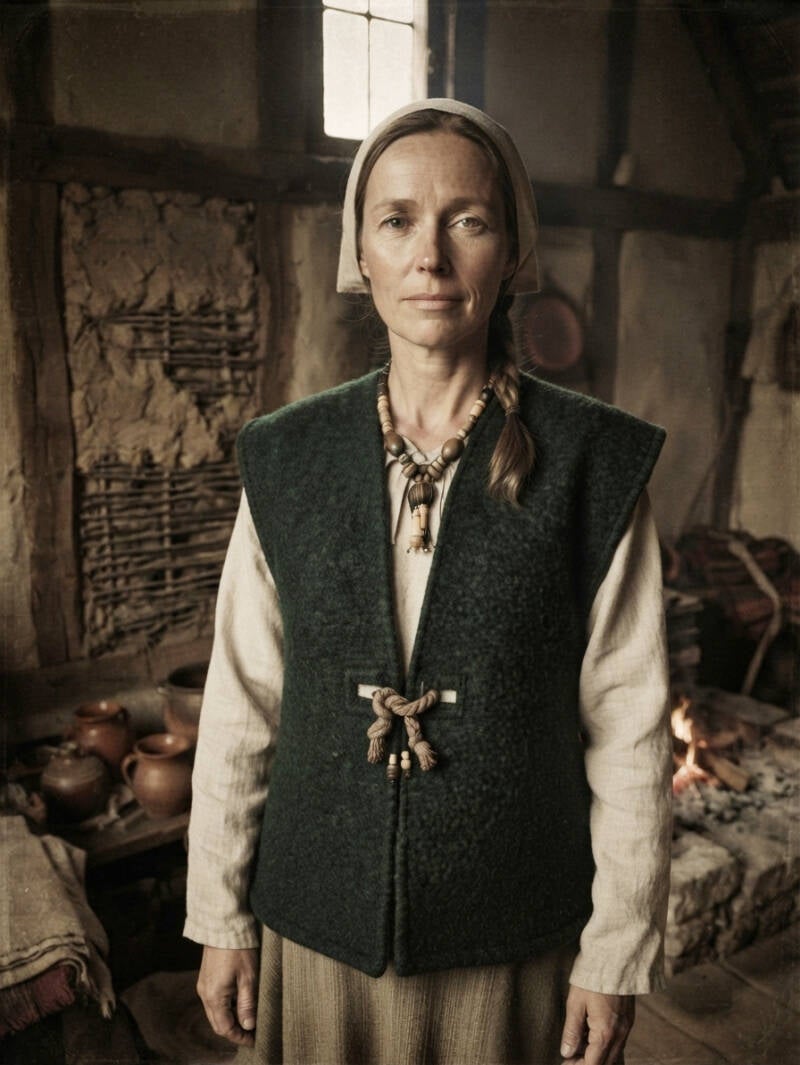
From an Old Wool Blanket to a Handmade Jerkin
Sometimes, the best fabric for a costume is not found in a fabric shop. Sometimes, it is already waiting at home!
For this project, I used a thick wool blanket that was no longer being used. It was incredibly thick and heavy. It was almost impossible to imagine using it for an ordinary sewing project.
But for a medieval-inspired costume? It was perfect!
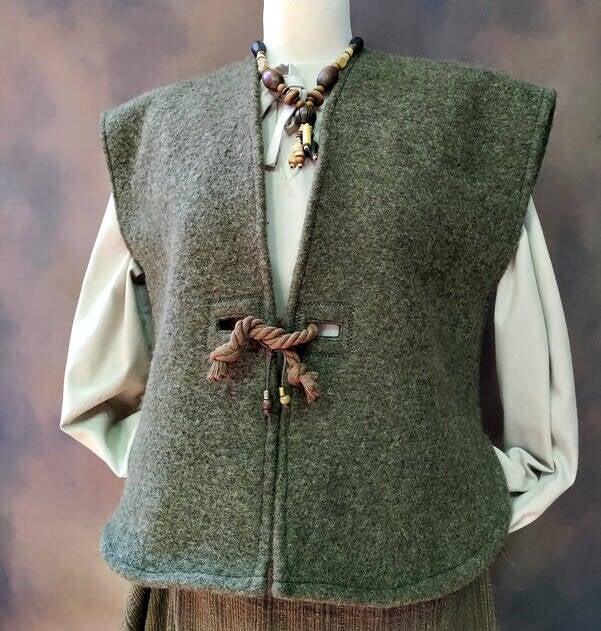
I decided to give the blanket a new life by turning it into a sleeveless wool garment. The result was a warm, practical vest with a rustic appearance. It looks wonderful over a simple linen shirt and works well with a medieval-inspired outfit.
I kept the design simple. The wool was already beautiful enough, so it did not need much decoration.
I made the buttonholes by hand, added a cord for the closure, and that was it. Sometimes, the simplest solutions are the best.
I have now successfully made and sold two of these garments.
And do you know what? I sometimes regret selling them!
I could really have used one myself during the colder months. Imagine wearing a thick wool garment over a linen shirt while working in my atelier on a chilly autumn or winter day. It would have been wonderfully warm.
But that is the life of a costume maker. Sometimes, you make something for someone else and only afterwards realise that you would quite like one yourself!
This project also made me think about the history of sleeveless garments, the old-fashioned jerkin, and the possibilities of recycling wool for historical costumes.
So, what exactly is a jerkin? How was it worn, and why is a simple wool vest such a useful addition to a historical-inspired wardrobe?
Let's have a closer look.
What Is a Jerkin?
A jerkin is a sleeveless or sometimes short-sleeved upper-body garment traditionally associated with men's clothing in Europe.
The term is particularly familiar from the sixteenth and seventeenth centuries. During these periods, jerkins were worn over a shirt or a doublet. They could be made from leather, woollen cloth, velvet or other fabrics, depending on the period, fashion and the wearer's social position.
Some jerkins were relatively simple garments. Others were carefully tailored and decorated.
A fashionable jerkin could have a fitted shape, a shaped waist and decorative details. Leather jerkins were also popular, particularly in certain forms of practical and military clothing.
The word jerkin does not describe just one unchanging design. Like many historical garments, its shape and use developed over time.
It is also important to understand the difference between a jerkin and a gambeson.
A gambeson was a padded textile garment associated with medieval armour and protection. It was generally made from layers of fabric, sometimes with additional padding. Depending on its design, it could be worn beneath armour or used as protective clothing in its own right.
A jerkin, on the other hand, was primarily an outer garment worn over other clothing. It was not necessarily padded.
Although these garments may look similar in some historical illustrations, they had different purposes.
My own garment is a sleeveless wool vest inspired by historical clothing. It is not a padded gambeson, nor is it intended as an exact reconstruction of a particular historical jerkin.
However, its shape and materials make it a practical choice for medieval-inspired costumes, fantasy clothing, LARP and theatrical use.
And that is what makes this project so interesting: a traditional idea can inspire a useful modern garment without pretending to be an exact historical reproduction.
Is a Jerkin Medieval or Renaissance Clothing?
This is an important question for anyone interested in historical costumes.
We often use the word medieval for a wide range of clothing styles, but historical fashion changed considerably over the centuries.
The Middle Ages are generally understood as the period between the fifth and the late fifteenth century in European history. The Renaissance followed, although the dates varied between regions.
The jerkin is particularly associated with the sixteenth and seventeenth centuries. This means that a historically accurate jerkin should not automatically be described as medieval.
However, sleeveless outer garments and layered clothing existed in different forms before and during the Middle Ages. Their names, construction and uses varied according to the time and place.
This distinction matters when creating historical costumes.
If I were making a costume for a specific historical character from the fourteenth century, I would research garments from that period rather than simply choosing a later jerkin design.
For a fantasy costume, LARP outfit or medieval-inspired character, there is more room for interpretation.
My wool garment belongs in that second category.
I like to call it a medieval-inspired wool jerkin because it communicates the look and purpose of the garment without making a claim of exact historical accuracy.
Historical inspiration gives us a wonderful starting point. Research helps us understand where that inspiration comes from, and good craftsmanship allows us to turn it into something practical.
The Historical Bodywarmer?
When I look at my wool jerkin, I cannot help thinking about the modern bodywarmer.
Both garments cover the torso while leaving the arms free. Both can be worn over a shirt, and both can provide an extra layer of warmth.
But the similarities should not be taken too far.
The historical jerkin was not simply an early version of today's bodywarmer. Its shape, construction and place in the wardrobe were different.
A traditional jerkin could be a fitted, fashionable garment, sometimes made from expensive fabric. A modern bodywarmer is usually designed for warmth, comfort and freedom of movement.
Still, the comparison is useful.
A sleeveless wool garment is practical because it keeps the body warm without restricting the arms. This is particularly useful when working, walking outdoors or attending an event in cold weather.
For a historical-inspired costume, it also creates an attractive layered appearance.
Wear it over a natural linen shirt, add a belt and a few simple accessories, and the outfit immediately gains character.
The combination of a pale shirt and darker wool works particularly well. The contrast shows the shape of the garment and gives the costume a simple, rustic appearance.
I think this is one reason why sleeveless wool garments remain so useful for historical-inspired clothing today.
They are practical, relatively straightforward to make and easy to combine with other garments.
Why Did the Jerkin Disappear from Everyday Clothing?
Historical garments rarely disappear overnight. More often, they change shape, receive a new name or become part of a different fashion.
The jerkin was an established part of European men's clothing during the sixteenth and seventeenth centuries.
As men's fashion developed, other garments became more important. Waistcoats, coats and different forms of jackets gradually took their place in the wardrobe.
The precise changes depended on the period and region.
By the eighteenth century, the waistcoat had become an important part of fashionable men's clothing, worn with a coat and breeches. Later changes in tailoring and everyday dress brought still more styles.
The modern bodywarmer belongs to a much later clothing tradition. It is not a direct replacement for the historical jerkin, although both garments offer the practical advantage of leaving the arms free.
Today, we usually encounter jerkins in historical collections, museums, theatre, film, historical reenactment and costume making.
That is a pity in some ways, because the basic idea remains useful.
A sleeveless outer garment can provide warmth without making it difficult to move. It can also be made from durable materials and designed to last.
My wool jerkin is a simple example of how this old-fashioned approach can still work today.
Why Wool Is Such a Good Material for Historical Costumes
Wool has a long history in European clothing.
For centuries, it was used for everything from everyday garments to expensive cloth for fashionable clothing. The quality depended on the fibres, the spinning, the weaving and the finishing.
Wool was particularly useful in cooler climates because it provides insulation and can help regulate temperature.
It also comes in many different weights and textures.
Fine woollen cloth can be smooth and elegant, while heavier wool fabrics can have a rougher, more rustic appearance.
For historical costumes, the choice of wool depends on the character and the intended use of the garment.
A wealthy Renaissance nobleman would not necessarily wear the same wool fabric as a rural worker. Likewise, a costume intended for a warm indoor performance may require a different material from one designed for an outdoor winter event.
For my jerkin, the thick wool blanket was ideal.
The fabric had enough body to create a substantial garment, and its texture suited the rustic appearance I wanted.
There was no need to add padding or extra layers. The blanket already provided plenty of warmth.
The material also had another advantage: I did not need to buy new fabric.
Instead, I could use something that was already available.
For a small atelier, this is a practical and satisfying way to work.
Recycling an Old Wool Blanket
I enjoy finding new uses for materials that might otherwise be forgotten.
An old blanket may no longer be needed as bedding, but that does not mean it has lost its value.
Depending on its condition and composition, it may be suitable for a completely different project.
In this case, the blanket was too thick and heavy for many ordinary garments. However, those same qualities made it suitable for a warm, sleeveless outer garment.
This is one of the advantages of recycling textiles: the material itself can suggest what it should become.
Rather than buying fabric for a particular pattern, you can begin with the fabric you already have and design a project around it.
Of course, not every blanket is suitable for clothing.
Before cutting into an old wool blanket, I recommend checking a few things.
1. Check the fibre content.
A pure wool blanket behaves differently from one made from acrylic or a wool blend. If natural fibres are important to your project, check the label or investigate the material carefully.
2. Examine the condition.
Look for holes, thin areas, moth damage, stains and weak spots. An old blanket may look fine at first but have areas that are no longer strong enough for clothing.
3. Consider the weight.
A thick blanket can be wonderfully warm, but it can also make a garment heavy. Think about how long the garment will be worn and how much freedom of movement is needed.
4. Clean it carefully.
Wool can shrink or felt if it is washed incorrectly. Follow suitable wool-care instructions and test an inconspicuous area before cleaning the entire blanket.
5. Plan the pattern before cutting.
Use the strongest parts of the blanket for the main pattern pieces. Avoid worn edges and damaged areas where possible.
6. Choose suitable sewing equipment.
Thick wool may require a suitable needle, strong thread and a sewing machine that can handle the material. Some parts may be easier to sew by hand.
The aim is to use the material wisely and avoid wasting fabric.
After all, recycling is not simply about using something old. It is about finding a new purpose for it.
How I Made My Wool Jerkin
For this project, I wanted a simple garment that would work well with a medieval-inspired costume.
The blanket was already thick and warm, so I did not need to add padding or complicated layers.
I concentrated on the shape and the finishing details.
The garment has a sleeveless design and a front opening. It can be worn comfortably over a shirt, making it useful for layered historical-inspired clothing.
I kept the decoration to a minimum.
The wool itself provides texture and character, so I did not want to cover it with unnecessary embellishments.
One of my favourite details is the fastening.
I made the buttonholes by hand and added a cord to close the garment.
Hand-sewn buttonholes take time, but they are a useful skill for anyone interested in traditional sewing.
They also allow you to finish a garment without relying on modern buttons, zips or plastic fasteners.
For this design, a simple cord was enough.
I like the way it looks against the thick wool. It is practical, understated and well suited to the rustic character of the garment.
A handmade costume does not always need elaborate decoration to look convincing. Sometimes, a few carefully chosen details are all you need.
The same principle applies to the rest of the outfit.
A simple linen shirt, a long skirt or a pair of suitable trousers, a belt and a few accessories can complete the look.
The result is a garment that is both practical and visually interesting.
How to Wear a Wool Jerkin for a Medieval-Inspired Costume
A sleeveless wool garment is easy to combine with other pieces of clothing.
For a simple medieval-inspired outfit, you could wear it over a linen shirt with a long skirt or loose trousers.
A leather belt can help define the waist and provide a place to attach a small pouch.
A wooden necklace or other simple accessories can add personality without making the costume look too elaborate.
For a rural character, I would choose natural colours such as brown, grey, dark green, beige and undyed linen.
For a fantasy character, you could experiment with stronger colours or more decorative fastenings.
The garment could also work for a traveller, craftsperson, villager or other character who needs practical clothing for an outdoor setting.
For LARP and theatre, a wool jerkin can be particularly useful because it creates a clear silhouette and adds another layer to the costume.
However, comfort is important.
A heavy wool garment should fit well at the shoulders and armholes. If the armholes are too tight, movement becomes difficult. If the garment is too heavy or too long, it may be uncomfortable to wear for an entire day.
It is worth testing the fit over the shirt you intend to wear underneath.
And remember that a thick garment can feel very warm indoors, especially during an active event.
For me, the best costume is one that looks right and can actually be worn.
What Else Can You Make from an Old Wool Blanket?
A wool blanket can be useful for many sewing projects.
The best choice depends on its thickness, weight, texture and condition.
For historical and medieval-inspired costumes, you might consider making:
-
A simple wool jerkin or sleeveless vest.
-
A rustic outer garment for a village character.
-
A warm shoulder covering.
-
A cloak, provided the blanket is not too heavy.
-
Accessories for a historical or fantasy costume.
-
Small bags or pouches from suitable leftover pieces.
A very thick blanket may be ideal for a short vest but too heavy for a long cloak. A softer blanket may drape better and work well for a different type of garment.
You can also use the remaining pieces for smaller projects.
This is particularly useful when working with large textiles. Rather than throwing away the offcuts, you can save them for another project.
I always find it satisfying when a material can be used almost to the last piece.
Of course, the quality and suitability of the fabric should come first. A worn or damaged section may not be suitable for clothing, even if it can still be used for another purpose.
The important thing is to look at the material with fresh eyes.
What was once a blanket might become a costume. What was once a curtain might become a skirt. And what appears to be an unpromising piece of fabric might turn out to be exactly what you need.
Is Recycled Fabric Historically Accurate?
This is an important question for anyone making historical costumes.
If your aim is to recreate a particular garment from a specific century, you need to research the original materials, construction and shape.
A modern wool blanket may not have the same weave, weight or finish as the wool cloth used during the Middle Ages or the Renaissance.
Likewise, a garment inspired by a sixteenth-century jerkin is not automatically suitable for a fourteenth-century historical reconstruction.
For a historically accurate costume, research should guide your choice of fabric and design.
However, not every costume needs to be an exact reconstruction.
For LARP, fantasy costumes, theatre, costume photography and many medieval-inspired outfits, appearance, comfort, durability and affordability can be equally important.
In these situations, recycled wool can be an excellent choice.
It allows you to create a useful garment while making good use of an existing textile.
I think it is important to be clear about the difference between historical reconstruction and historical inspiration.
Both approaches have their place.
One aims to reproduce the past as closely as possible. The other uses historical clothing as a starting point for a new design.
At Historique Couture, I enjoy exploring the possibilities of historical clothing while finding practical solutions for the costumes I make.
Sometimes, that means researching a particular period in detail. At other times, it means looking at an old blanket and imagining what it could become.
Handmade Historical Costumes: The Beauty of Simple Solutions
At Historique Couture, I make costumes and garments by hand in my own small atelier.
Every project is different.
Sometimes, I begin with a historical pattern. Sometimes, I work from paintings, photographs or film references. And sometimes, the material itself provides the inspiration.
This wool jerkin began with a blanket that was no longer being used.
Its thickness made it unsuitable for many ordinary sewing projects, but it worked beautifully for a simple, warm garment.
I did not need expensive embellishments or complicated techniques. I needed a suitable shape, a practical fastening and a little patience.
That is one of the things I enjoy most about sewing: finding the right solution for a particular project.
A material that seems useless to one person may be exactly what another maker needs.
Traditional sewing techniques also have an important place in my work.
Hand-sewn buttonholes, wool fabric and simple cord fastenings give this garment its character. They are small details, but they make a difference.
I like working with materials that have a story of their own.
An old blanket has already had a life before it reaches my sewing table. By turning it into a garment, I give it another purpose.
And that is one of the most rewarding aspects of handmade clothing.
Would I Make Another Wool Jerkin?
Absolutely!
Although I have already made and sold two of these garments, I would not mind making another one for myself.
I can imagine wearing it over a linen shirt on a cold autumn or winter day. It would be particularly useful when working in my atelier.
Perhaps I would choose a slightly different shade of wool next time. Or perhaps I would experiment with another fastening.
That is the advantage of making things by hand. Every project teaches you something, and the next version can be a little different.
And if I happen to find another thick wool blanket that nobody wants, I will know exactly what to do with it.
Although, this time, I might be tempted to keep the finished garment!
An old blanket does not have to remain an old blanket. With a little imagination, it can become a warm, practical garment with a new story to tell.
For me, that is the beauty of handmade costume making: combining traditional techniques, creative thinking and the careful use of materials.
Sometimes, the best fabric is the fabric you already have.
Have You Ever Recycled Fabric for a Costume?
Do you enjoy making historical or fantasy costumes from recycled materials?
Have you ever turned an old blanket, curtain or other unwanted textile into something completely different?
I would love to hear about your projects and creative solutions.
At Historique Couture, I believe that handmade clothing should be personal, practical and made with care. Sometimes, the most interesting projects begin with something we already have.
Add comment
Comments