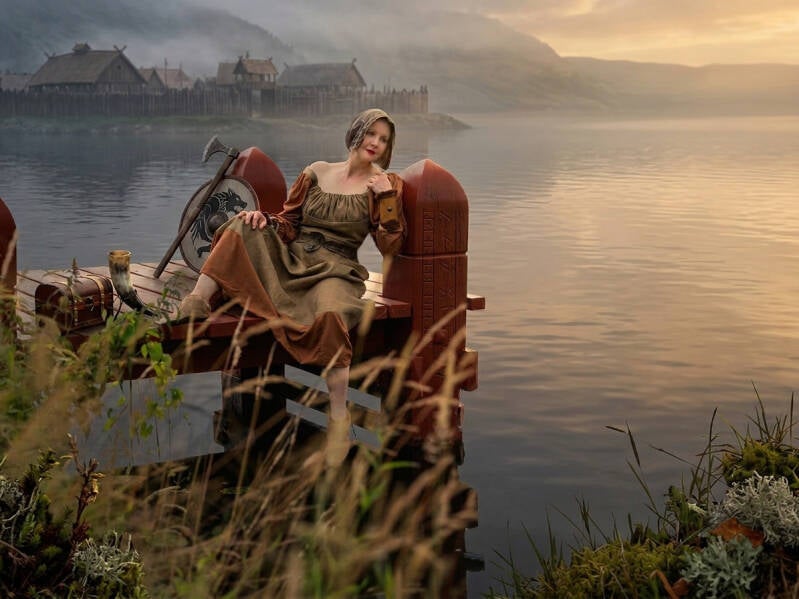
How One Rainy Pony Camp Changed the Way I Look at Costumes
People often ask me where my inspiration comes from.
Sometimes the answer surprises even me.
If someone had told the teenage girl sitting on the floor of a pony camp on the Dutch island of Ameland that she would one day design fantasy costumes inspired by Viking clothing, I probably would have laughed.
Yet that is exactly where it all began.
A Rainy Week on Ameland
I must have been around fourteen or fifteen years old when I went to a pony camp on Ameland.
Like every horse-loving girl, I imagined spending the entire week riding across the dunes.
Instead, the first few days were a disappointment.
It rained almost all day.
When the weather finally improved, the heat arrived—and so did the horseflies.
The outdoor rides became shorter because both we and the ponies were exhausted. After every ride, the horses deserved a well-earned rest.
So what did a group of teenage girls do?
We bought bottles of sparkling lemonade that cost only twenty cents, a bag of liquorice, stretched out on the floor in front of a tiny television and talked for hours.
About school.
About horses.
About the riding school.
About boys.
And meanwhile, we watched the same Viking film over and over again.
There was not much choice in those days.
Films were rented by the week, and this happened to be the one available.
I honestly cannot remember much of the story anymore.
But I remember the costumes.
Iceland Became My First Viking World
The film had been shot in Iceland.
The Viking warriors rode Icelandic horses.
At first, that looked rather strange to me.
The horses seemed so small compared to the enormous men riding them.
Of course, today I know that Icelandic horses may be pony-sized, but they are incredibly strong, sure-footed and perfectly suited to rough landscapes.
After only a few scenes, I stopped noticing their height.
Instead, I noticed something else.
The horses looked as though they belonged there. (As they did!)
The riders looked as though they belonged there.
And the costumes belonged there too.
Long manes flew through the wind nearly all the time!
Heavy wool cloaks moved with every step.
Leather belts held practical tools.
Everything looked rugged.
Everything looked believable.
Nothing felt like a costume.
It felt like real clothing.
Looking back now, I think that may have been the first time I realised that costume design can make an imaginary world feel completely real.
Viking Clothing Is Often Misunderstood
Many people imagine Vikings wearing horned helmets, rough fur and little else.
That image mainly comes from nineteenth-century opera and popular culture.
The real picture is much more interesting.
Viking clothing was surprisingly well made.
People valued good craftsmanship.
Both men and women cared about appearance, and clothing showed wealth, family connections and social status.
Most garments were made from wool and linen.
Wool was ideal for the cold Scandinavian climate.
It kept people warm, even when it became damp.
Linen was softer against the skin and commonly used for undergarments and summer clothing.
The wealthy could afford imported silk from distant trade routes.
Natural dyes created beautiful colours such as deep blue, reddish brown, green, yellow and soft red.
Contrary to popular belief, Viking clothing was often much more colourful than we imagine today.
Simple Shapes, Clever Construction
One of the things I admire most about Viking clothing is its simplicity.
Unlike later medieval fashion, Viking garments followed relatively straightforward geometric shapes.
Large rectangles.
Squares.
Gussets.
Triangles.
Almost every piece of fabric had a purpose.
Very little was wasted.
As someone who makes costumes myself, I find that fascinating.
Sometimes the simplest pattern creates the strongest silhouette.
Viking Clothing and Medieval Clothing Are Not the Same
People often mix Viking clothing with medieval clothing, but they belong to different periods and have very different styles.
Viking clothing was practical.
It was designed for farming, travelling, sailing and surviving harsh weather.
Decoration was usually found in woven trims, embroidery, jewellery or beautifully made brooches.
The clothing itself remained functional.
Later medieval fashion became increasingly tailored.
Sleeves became tighter.
Waistlines appeared.
Gowns followed the shape of the body more closely.
Rich velvets, elaborate embroidery and luxurious fabrics became important symbols of wealth and power.
As a costume maker, I enjoy both styles.
Medieval clothing often feels elegant.
Viking clothing feels honest.
Strong.
Grounded.
Timeless.
The Language of Viking Symbols
Another aspect that fascinates me is the symbolism.
The Vikings rarely decorated something without meaning.
Ravens honoured Odin and represented wisdom, memory and thought.
Wolves symbolised strength and loyalty but could also represent chaos and destiny.
Dragons protected ships and homes while frightening enemies.
The Tree of Life, Yggdrasil, connected all worlds and reminded people that everything was linked together.
Knots with endless lines symbolised eternity.
The Valknut became associated with Odin and fallen warriors.
Runes were more than letters.
Many people believed they carried power, protection or blessings.
Whether every Viking believed these meanings exactly as we interpret them today is still debated by historians.
But there is no doubt that symbols played an important role in Viking art and identity.
I love that.
A costume becomes much more interesting when every detail tells part of a story.
Years Later...
Many years passed before Viking clothing entered my life again.
This time, it was not through a film.
I became fascinated by the famous Skjoldehamn costume while researching historical clothing.
That discovery opened an entirely new world for me.
The construction.
The fabrics.
The sewing techniques.
The practical solutions.
The incredible craftsmanship.
But that story deserves a blog of its own.
Inspiration Never Really Leaves You
Looking back now, I realise that inspiration sometimes waits patiently for years.
A rainy week on Ameland.
A tiny television.
A rented Viking film.
A group of horse-loving girls with lemonade and liquorice.
At the time, I had no idea those memories would stay with me for decades.
Yet every now and then, when I design a fantasy cape, choose a heavy wool fabric or combine leather with earthy colours, I think perhaps that Viking film never really left me.
Maybe that is how inspiration works.
It quietly follows us through life until one day we recognise it in something we have created with our own hands.
-
 Viking Hood Patchwork Medieval €235.00
 -
 Lined Viking Hood Luxe Wool €125.00
 -
 Woolen Silk-Lined Viking Hood €165.00
 -
 XXL Viking Hood Skjoldehamn €185.00


"P.S. The image is real. Photographer: Erik Bolding. Location: Bourtange, the Netherlands. AI enhanced the background, transforming me into a true Viking lady, reminiscing about the days of my youth."
Add comment
Comments