Out-of-the-Box Sewing: When Bigger Really Is Better
Before I started making historical costumes, I spent many years working as a model.
I did quite a lot of photo shoots, including TFP shoots for my own portfolio. TFP means “Time for Prints” or “Time for Photos”. In simple words, the photographer and the model both give their time, and everyone gets photographs for their portfolio.
It was a wonderful way to learn.
I worked with different photographers and, little by little, I learned something very important:
Some things look completely different in a photograph than they do in real life.
And that discovery changed the way I sew.
Learning to See Through the Camera
When you make clothing for everyday life, you normally think about proportion, comfort and practicality.
But artistic photography is different.
Sometimes, more really is more.
A normal hat can look rather ordinary in a photograph. A huge hat can suddenly make the whole image interesting.
A normal collar may disappear.
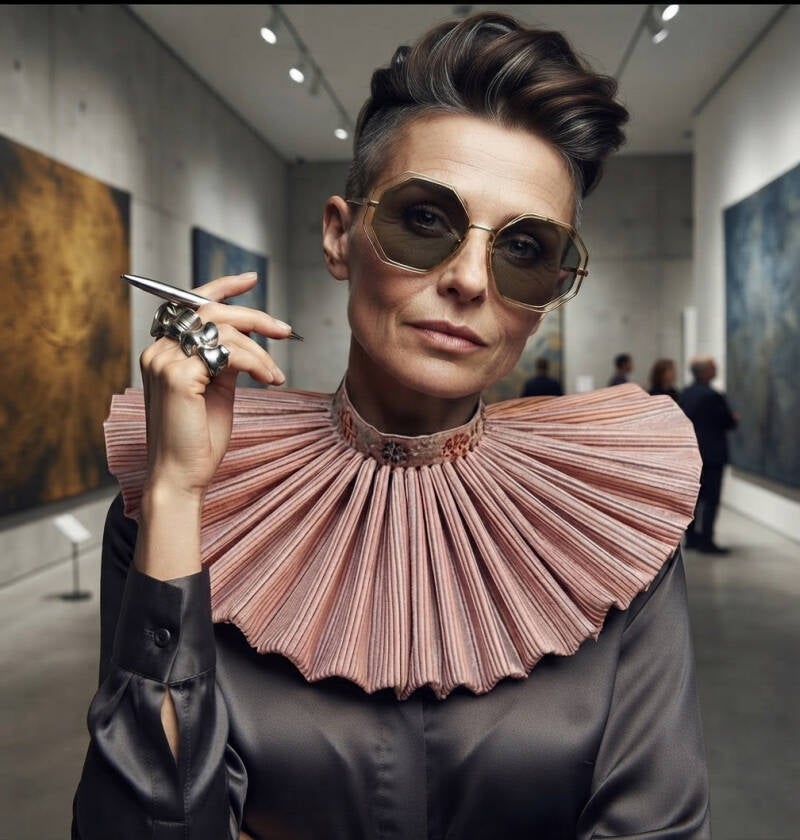
A very large ruff collar can become the main subject of the photograph.
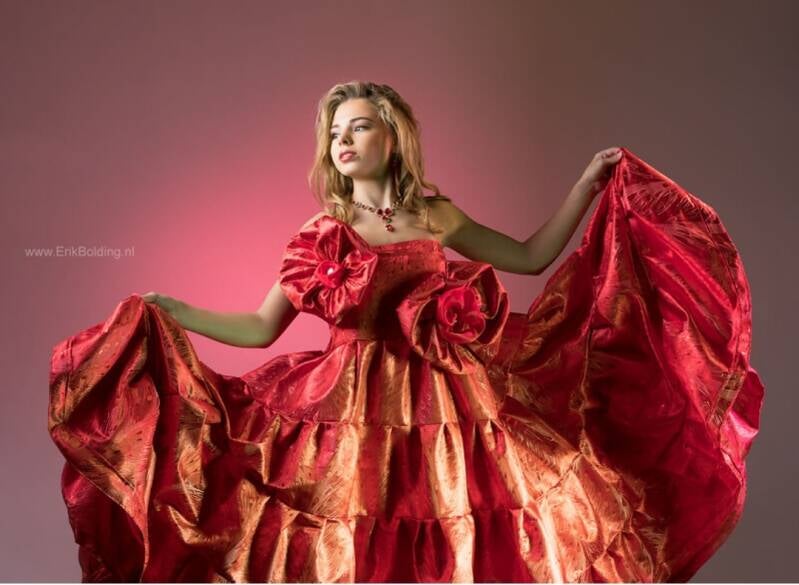
And a skirt that would be completely impractical in daily life can look absolutely spectacular when it is several metres wide.
So I started making things bigger.
Much bigger.
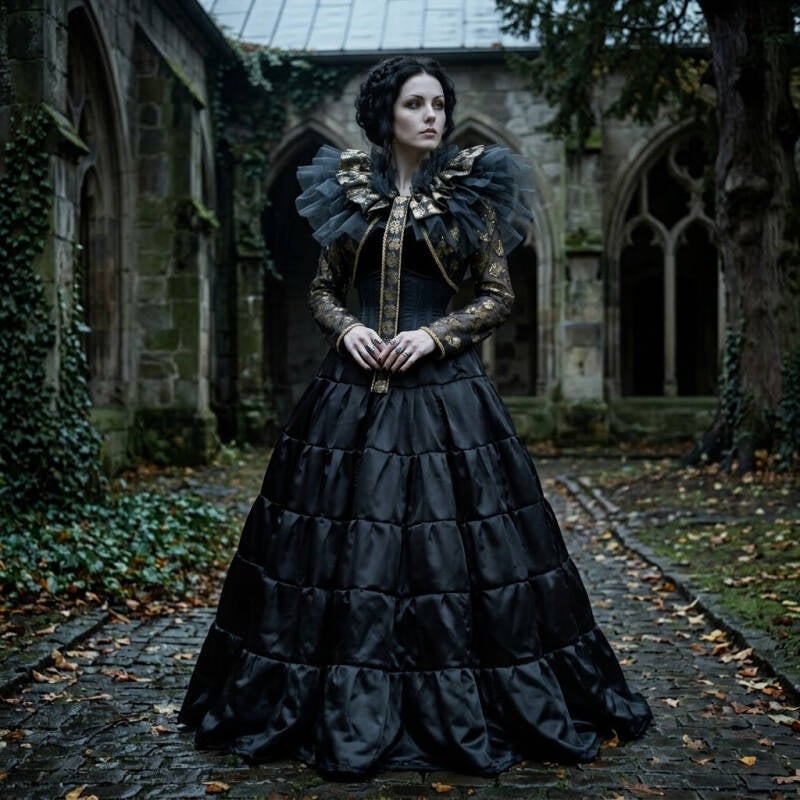
I made enormous hats, huge ruff collars, very wide skirts and giant dresses. One of my skirts had a diameter of about 12 metres!
Yes, twelve metres.
It was not exactly something I could wear to the supermarket.
But in a photograph?
It worked.
Out-of-the-Box Sewing
This is what I now call out-of-the-box sewing.
It is not simply making something large.
That is actually much more difficult than it sounds.
If a photographer asks for a very large hat, for example, you cannot simply make a normal hat and multiply all the measurements.
Very quickly, the proportions become wrong.
The hat may become so large that the model disappears underneath it. Or it may become too heavy and start falling over.
The same happens with skirts, dresses and ruff collars.
You want something spectacular, but you still want to see the person wearing it.
Otherwise, instead of a beautiful fashion photograph, you may end up with a very well-dressed mushroom.
And that is usually not the intention.
Making Something Huge Without Losing Its Character
This is one of the things I enjoy most.
How do you make something much larger than normal while keeping its original character?
A ruff collar should still look like a ruff collar.
A hat should still look like a hat.
A skirt should still look like a skirt, rather than a small circus tent.
And the model should still look like a person.
The proportions between the model and the costume are very important.
Sometimes the answer is to make one part much larger while keeping another part relatively small. Sometimes you need a completely different construction technique to support the extra size.
And sometimes you need to build something that looks delicate but is actually surprisingly strong.
That is where ordinary sewing techniques are not always enough.

The Fabric Can Make All the Difference
There is another part of out-of-the-box sewing that I absolutely love: unusual fabrics.
Some fabrics simply catch the eye.
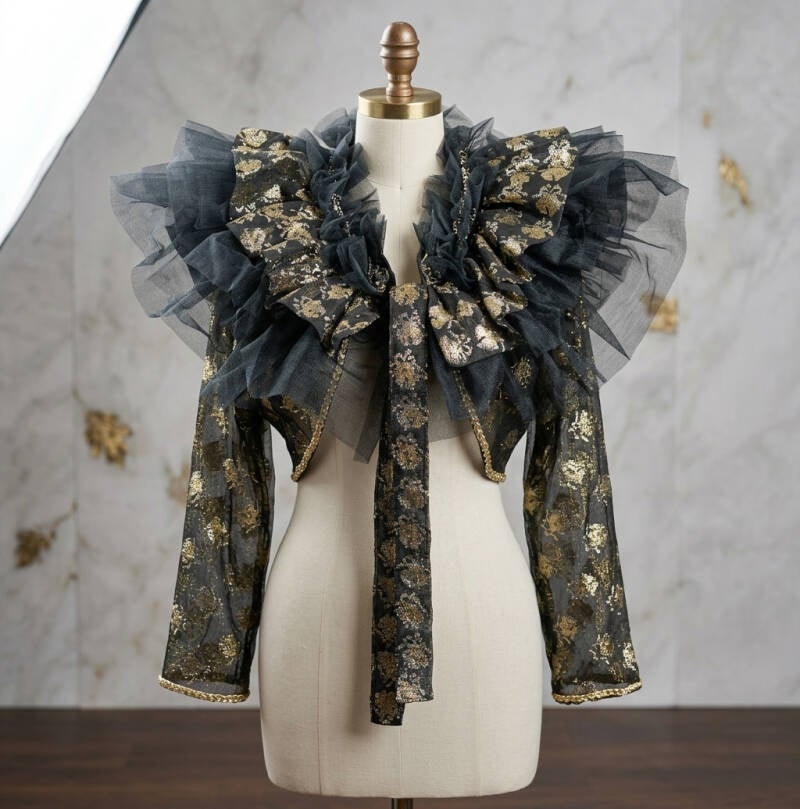
Organza is a good example. It can create volume without becoming visually heavy.
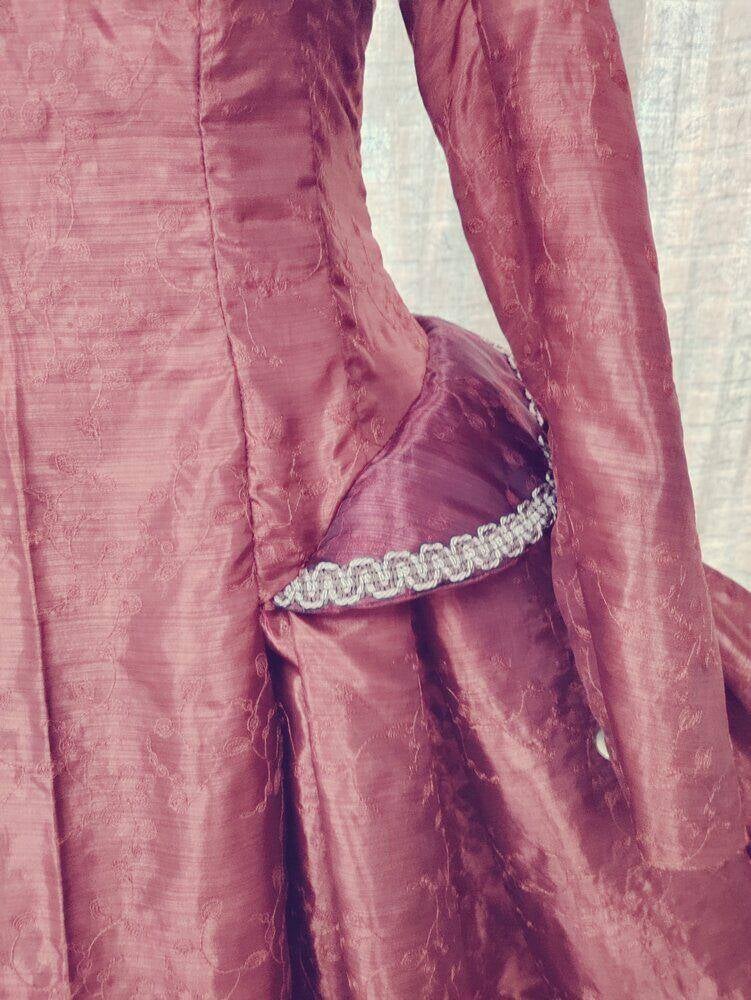
Korean silk jacquards can give an enormous amount of colour, texture and movement.
And beautiful fabrics with large patterns can become almost like artwork when they are used on a very large garment.
This means that out-of-the-box sewing is not only about making things bigger.
It is also about choosing materials that are not necessarily the obvious choice.
Sometimes the fabric itself becomes part of the design.
And sometimes a fabric that looks rather strange on the cutting table suddenly makes perfect sense when you see it through a camera lens.
And What Does This Have to Do With Historical Costumes?
Everything.
At first glance, you might wonder what enormous fashion pieces and historical costumes have in common.
For me, the answer is simple.
Atmosphere.
When I make a historical costume, I do not only want to reproduce a piece of clothing.
I want to capture something of the feeling of the period.
That often means looking beyond the obvious.
How did the silhouette work?
How much volume was there?
Where did the eye go first?
How did the fabric move?
What happened when the wearer walked into a room?
Historical clothing was often much more dramatic than our modern everyday clothing.
Large sleeves, wide skirts, enormous collars, elaborate hats and strong silhouettes were part of fashion in different periods.
So my experience with photography taught me something that I now use in costume making:
Do not always think inside the modern box.
If you want to recreate the feeling of the past, sometimes you have to think a little differently.

I Have Made Plenty of Mistakes
Of course, not everything I made worked.
Far from it.
I have had hats so large that the model almost disappeared underneath them.
I have used fabrics that looked beautiful on the table but completely failed in photographs.
Some fabrics reflected the studio lights so strongly that the beautiful texture disappeared.
I have made a dress that made the model look rather like a Michelin woman.
Not the fashion effect I was hoping for.
And I have made corsets that would probably have made even Dita Von Teese or a Kardashian ask for a little more breathing room.
The problem was not the model.
The problem was my proportions.
They were wrong.
Not slightly wrong.
Wrong by quite a lot.
That is one of the humbling things about sewing for photography. Something can look perfectly reasonable while you are making it, and then the camera tells you the truth.
The camera is not always kind.
But it is a very good teacher.
What I Have Learned
Over the years, I have learned that making something spectacular is not simply a question of making it bigger.
It is about control.
You need to understand proportion, balance, weight, fabric behaviour, structure and, of course, the human body.
You also need to understand what the camera sees.
A costume can look enormous in the studio and still look surprisingly normal in a photograph.
And the opposite can happen too. Something that looks beautifully dramatic in real life can become rather flat and disappointing in a photograph.
That is why I enjoy this kind of sewing so much.
It is part costume making, part fashion, part engineering and sometimes, quite honestly, part problem solving.
What Have I Made So Far?
Over the years, my experiments have included very large hats, enormous ruff collars, extremely wide skirts, oversized dresses, a crinoline cage and even scarves so large that you could almost live inside them.
I may be exaggerating slightly about the last one.
Only slightly.
And I am certainly not finished experimenting.
I would like to share more of what I have learned in future blogs in my How-To section. I will talk about some of the techniques I use when making unusually large pieces, how to keep them strong, how to choose fabrics and how to keep the proportions flattering.
Because making something “big” is easy.
Making something big, beautiful and believable is much harder.
That is where the real craft begins.
Thinking Outside the Sewing Box
Looking back, I think my years as a model taught me almost as much about costume making as my years behind the sewing machine.
I learned to look at clothing from the other side of the camera.
I learned that exaggeration can make an image stronger.
I learned that beautiful fabrics can completely change a design.
And I learned that sometimes the most interesting sewing starts when you stop asking, “How is this normally done?”
and start asking,
“What if I did it differently?”
That is what I mean by Out-of-the-Box Sewing.
It is sewing without being afraid of a little exaggeration, a little experimentation and, occasionally, a spectacular mistake.
And I think that is exactly what makes costume making so much fun.
Out of the Box items for Sale or Made to Order:
All BIG eyes on you!
-
 Custom Two-Tone Organza Couture Skirt 1 Layer €295.00 FREE shipping
 -
Last one!

-
 Custom Two-Tone Organza Couture Skirt 2 Layers €394.00 FREE shipping
 -
 Statement Hat Oversized Couture €315.00 FREE shipping
 -
 Giant Nightmare Circus Jester Hat €255.00 FREE shipping
 -
 Custom Giant Jester Hat Long Wings Cosplay €295.00 FREE shipping
 -
 Elizabethan Edwardian Corset Exclusive with Big Sleeves Blouse €525.00 FREE shipping

Add comment
Comments