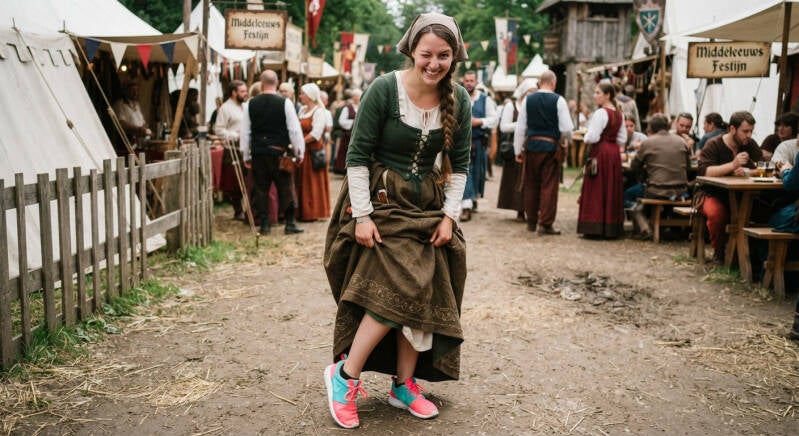
Medieval costumes, LARP clothing and historical re-enactment costumes do not have to be uncomfortable.
In fact, I make many of my historical costumes with comfort in mind.
Because wearing a costume for a photograph is one thing.
Wearing it for an entire day — or even an entire weekend — is something completely different.
You have to be able to live in it
When I make historical clothing for re-enactment or LARP, I always think about what the person will actually do while wearing it.
Will they walk all day?
Sit down?
Work?
Carry things?
Be outside for many hours?
Perhaps they will wear the costume for several days.
This is especially important when I make costumes for the staff of the historical town of Bourtange. These costumes are based on clothing from around 1742, but the people wearing them are not simply standing around for a photograph.
They work in them.
For a long time.
That means the costumes have to look historically appropriate, but they also have to be practical.
A skirt does not have to be difficult
Take a historical skirt.
I can make the waistband with elastic so that it is comfortable throughout the day. Sometimes I also make it adjustable.
Because real people change.
Perhaps you gain a few kilos.
Perhaps you lose some.
A costume does not have to become useless because your body changes a little.
I also like historical skirts to be long — often right down to the floor.
And what about shoes?
Sneakers underneath? No problem.
If the skirt is long enough, nobody will see them.
You get the historical appearance without having to walk around all day in uncomfortable shoes.
That small detail can make a surprisingly big difference.
A waistcoat should not feel like a corset
The same goes for a historical waistcoat or gilet.
It should fit properly, but I do not want my clients to feel as if they are wearing a tight corset all day.
So I make room for adjustment.
It can be laced or fastened more tightly when needed, or worn a little more loosely when comfort is more important.
Sometimes I even use a suede-look fabric with a little stretch.
You hardly notice the stretch when you look at the costume.
But the person wearing it certainly notices the difference.
And that is exactly the point.
Choosing the right cotton
Blouses are another good example.
For costumes that are going to be worn often, I like washed cotton.
It can be washed again and again, and it develops a lovely, soft character.
A linen blend can also be a very good choice, especially when you want the natural look of linen without quite as much creasing.
Poplin cotton is another practical option.
And for someone who does not mind ironing now and then, good pure cotton is still a wonderful fabric.
The fabric should suit the person who is going to wear the costume, not just the historical image we are trying to recreate.
Historical does not have to mean uncomfortable
I think this is one of the most interesting parts of making historical clothing.
We often imagine that people in the past were terribly uncomfortable in their clothes.
But much of their clothing was designed for everyday life.
They had to walk, work, sit, carry things and spend long days in their clothes too.
So when I make a historical costume today, I try to respect the original appearance while also remembering that my client is a modern person who has to wear it for hours.
The result should be beautiful.
It should look right.
But most importantly, it should feel good.
And I cannot tell you how many times I have heard the same thing from a client:
“I could wear this every day.”
Perhaps the clothing of the past was not so impractical after all.
-
 Medieval Long Minimalistic Linen Cloak Brique €265.00 FREE shipping
 -
 Made to Measure Medieval Costume, XS - XXXL €695.00 FREE shipping
 -
Sale!
 Plus Size Medieval LARP Vest | Made to Measure €245.00
€295.00 -
 Medieval LARP Gilet Nobleman €85.00


Add comment
Comments