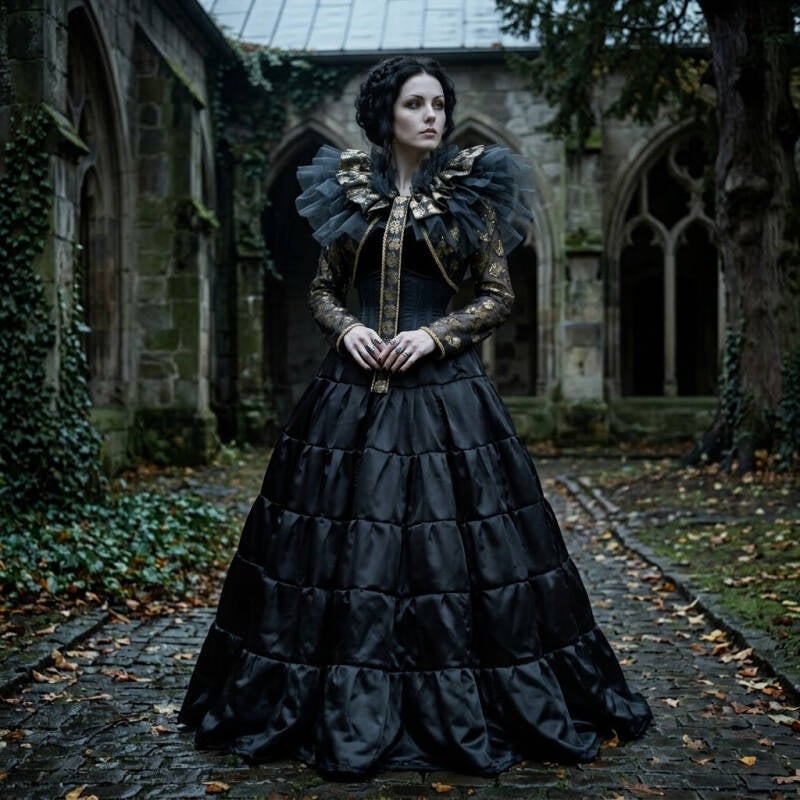
There is something about autumn that makes people want to dress up.
Not just a little.
We suddenly want witches, vampires, ghosts, monsters, dark fairies, medieval warriors and creatures that probably should not be allowed anywhere near the front door.
And I love it.
As a costume maker, Halloween is one of those times of year when I can let my imagination run a little further than usual.
But where did the tradition of Halloween costumes actually come from?
From Samhain to Halloween
The story begins long before the modern Halloween party.
One important part of the history is Samhain, an old Gaelic festival connected with the end of the harvest and the beginning of winter. It marked an important seasonal change and, in traditional beliefs, was also a time when the boundary between the living and the supernatural world was thought to be less clear.
Samhain was not simply “ancient Halloween”. The modern Halloween tradition developed over many centuries and also became connected with Christian celebrations such as All Saints' Day and All Souls' Day.
The evening before All Saints' Day became known as All Hallows' Eve, which eventually became Halloween.
Over time, older seasonal traditions and Christian customs mixed together. Later still, Halloween developed into the celebration we know today, with costumes, parties, pumpkins, ghosts, witches and, of course, an astonishing amount of sweets.
And somewhere along the way, dressing up became one of the most enjoyable parts.
Why Do We Dress Up?
This is where things become particularly interesting for someone who makes costumes.
There are stories connecting early Halloween and Samhain traditions with disguises, spirits and the supernatural. Historical evidence for the exact practices of the earliest celebrations is limited, so we should be careful about presenting every modern Halloween story as ancient fact.
What we do know is that costume traditions became part of Halloween and related celebrations over time.
In Scotland and Ireland, for example, guising became a tradition in which people, especially children, dressed up and went from house to house. They might perform a song, joke or trick in return for food or treats.
The modern trick-or-treat tradition developed much later, particularly in North America.
So the Halloween costume has had quite a journey.
From folklore and disguises to witches and ghosts.
From handmade costumes to shop-bought costumes.
And today, anything seems to be possible.
Which brings me to Bourtange.
-
 Gothic Baroque Corset Dress €395.00 FREE shipping
 -
 Halloween Horror Gothic Corset €175.00
 -
 Gothic Lace Chest Collar €95.00
 -
 Gothic Ruff Collar Dark Romantic €255.00 FREE shipping
Magisch Samhain in Bourtange
I live close to Bourtange, a beautiful historic fortified village in the north of the Netherlands.
Once a year, the old fortress becomes something completely different.
Magisch Samhain brings together fantasy, history and spectacle. There are fire shows, performers, stilt walkers and all kinds of wonderful and strange characters. Visitors are encouraged to dress up too, and many people really take the opportunity to be creative.
In 2026, Magisch Samhain takes place on 31 October and 1 November in Vesting Bourtange.
I love going there and simply looking at the people.
There are always costumes that make me stop and think:
How on earth did they make that?
And sometimes:
Why did I not think of that myself?
That is one of the great things about fantasy events. People are not afraid to be imaginative.
A Skirt That I Still Look For
I once sold a skirt that was about two metres long to a stilt walker.
Yes, a two-metre skirt.
I have never forgotten it.
Ever since, whenever I visit Magisch Samhain, I sometimes find myself looking around to see if I can spot it again.
Perhaps the skirt is still out there somewhere, living its best fantasy life.
This is one of the reasons I enjoy these events so much. People are not afraid to make something unusual.
And for a costume maker, that is wonderful.
The Darker, the Better
There is another thing I have noticed about Halloween costumes.
They can never seem to be too dark.
Black?
Good.
Very dark grey?
Good.
Black with a little more black?
Even better.
Add some old-looking leather, a few chains, strange jewellery, a hood, a pair of horns and perhaps something that looks as though it came out of a medieval crypt?
Now we are getting somewhere.
I have made Dracula capes, dark jester hats, sinister fantasy pieces and other costumes that belong much more comfortably in a mysterious castle than in my living room.
And after a few weeks of making dark costumes, I usually reach a point where I desperately want to sew something with flowers.
And white lace.
And perhaps a little pale pink.
Something cheerful.
Something innocent.
Something that does not look as if it has just escaped from a haunted forest.
Why Halloween Is So Much Fun for a Costume Maker
For me, Halloween is not really about making the scariest costume possible.
It is about atmosphere.
A good costume tells you something before the person wearing it has even said a word.
A long black cape creates a different feeling from a Victorian dress.
A huge ruff collar can make someone look strange and mysterious.
A jester hat can be funny and playful — or deeply unsettling.
The same basic idea can move from fantasy to horror simply by changing the colour, fabric, shape and details.
That is what I love about costume making.
Clothing can tell a story.
From Historical Costume to Horror Costume
This is also where my work with historical costumes and Halloween costumes meet.
Historical clothing gives us an enormous amount of inspiration.
The past was full of dramatic silhouettes, elaborate headwear, unusual collars, long cloaks, wide skirts and beautifully detailed fabrics.
You do not always have to copy an historical costume exactly.
Sometimes you can take one element and push it further.
Make the collar larger.
Make the skirt wider.
Make the sleeves longer.
Make the hat completely ridiculous.
And suddenly you have something that feels like fantasy, horror or theatrical fashion.
This is one of the reasons I call some of my work out-of-the-box sewing.
The rules are useful.
But sometimes it is much more interesting to know the rules first — and then decide which ones you want to bend.
Halloween, Horror and the Joy of Dressing Up
Perhaps this is why Halloween has survived and changed so much over the centuries.
It gives us permission to become someone else for a while.
A vampire.
A witch.
A ghost.
A jester.
A medieval character.
A creature from a fairy tale.
Or simply something that would make absolutely no sense on an ordinary Tuesday afternoon.
And I think that is a very good reason to celebrate.
For one evening, we can leave everyday clothing behind.
We can be dramatic.
We can be mysterious.
We can be ridiculous.
We can be frightening.
And, if we are lucky, we can wear something we made ourselves.
That is my favourite kind of Halloween.
A Little More History, A Little More Magic
The history of Halloween costumes is a mixture of old seasonal traditions, religious celebrations, folklore, local customs and much more modern popular culture.
It is not one straight line from ancient Samhain to the Halloween costumes we buy today.
It is much more interesting than that.
Traditions change.
People add their own ideas.
Old customs are forgotten, revived or given a new meaning.
And costume makers keep turning fabric into something that was not there before.
That is perhaps why I enjoy Halloween so much.
It connects history with fantasy.
And history with imagination.
And, of course, it gives me a very good excuse to make something wonderfully dark.
Although after Halloween, I may need a little time with my flowers and white lace again.
-
 Dark Gothic Statement Collar €125.00
 -
 Custome Made Dark Academia or Fantasy Collars €350.00 FREE shipping


Coming Next
This is the first blog in my Halloween and Horror series.
In the coming weeks, I will share some of my own costumes and talk about the ideas and techniques behind them — including Dracula, dark jesters, large collars and other pieces made for the darker side of costume making.
Because sometimes a little bit of darkness is exactly what a costume needs.
Add comment
Comments