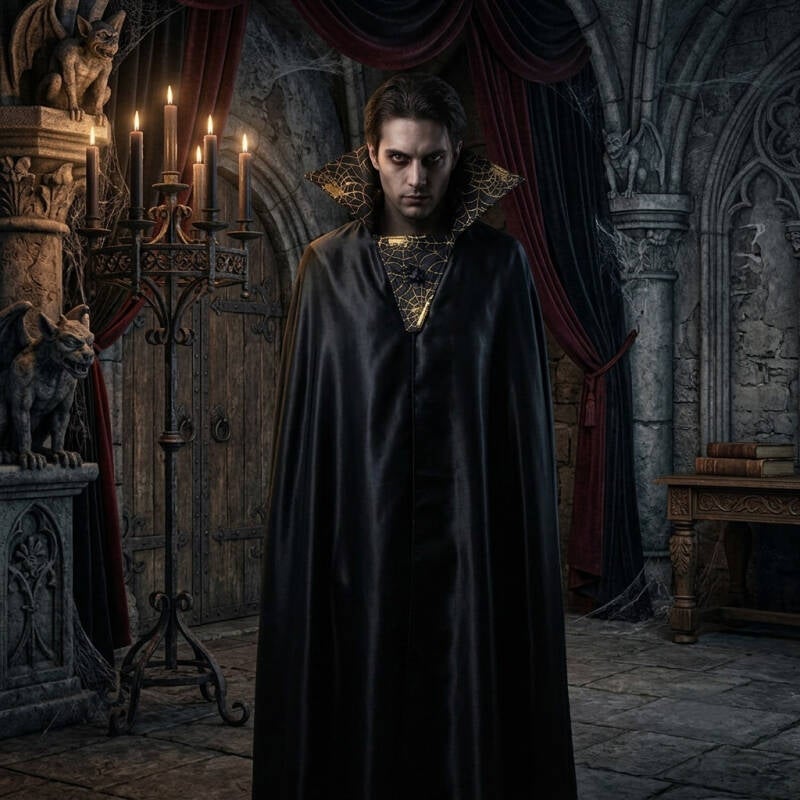
Why a Cape Always Looks Mysterious: The Magic of the Dracula Cape
There are some garments that immediately create a mood.
A long black cape is one of them.
Put one on and, suddenly, you are no longer simply walking into a room.
You are entering a castle.
Or a haunted forest.
Or perhaps you have just arrived from Transylvania.
And if the cape has a tall collar, black fabric, a red lining and a few spiders, there is really no doubt anymore.
You are Dracula.
A Dracula Cape Made from Satin?
“Budget satin?”
Yes. Absolutely.
Satin is, in my opinion, one of the most underestimated fabrics for costume making.
People sometimes think of satin as cheap-looking or suitable only for very shiny evening dresses. But that really depends on the quality of the fabric, the colour, the way it is cut and, most importantly, how it is used.
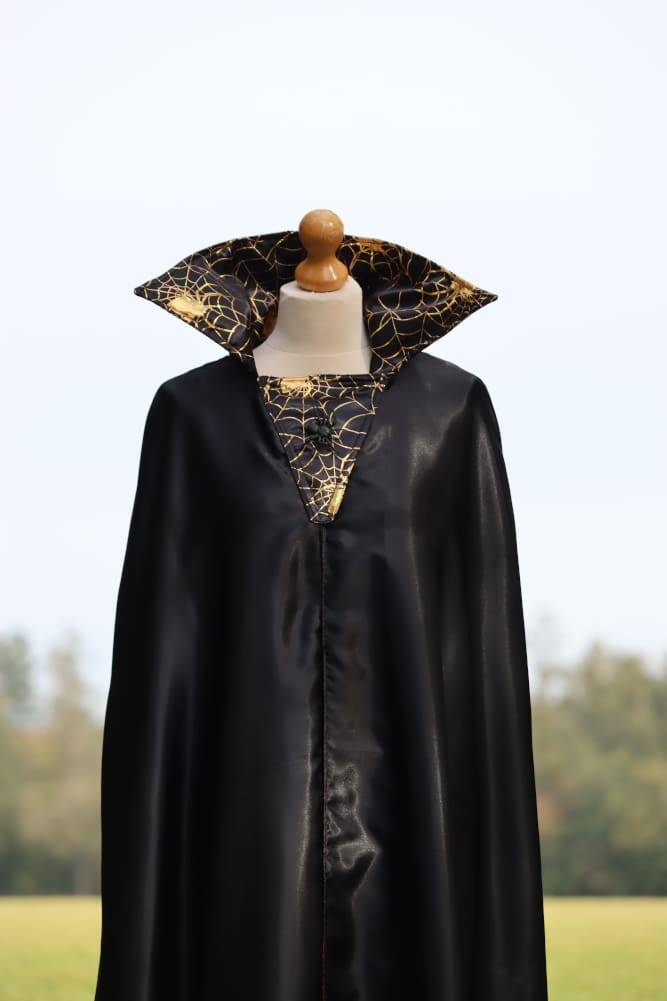
For this Dracula cape, I made the most of what satin can do.
The outside is dark and dramatic, while the red lining gives the cape that wonderful flash of colour when it moves.
And movement is important.
A cape is not just a large piece of fabric.
It is part of the performance.
When the wearer turns around, the lining appears. When the cape moves, the fabric catches the light. When the wearer stands still, the long silhouette creates an entirely different feeling.
That is exactly what I wanted.
The Collar Makes the Costume
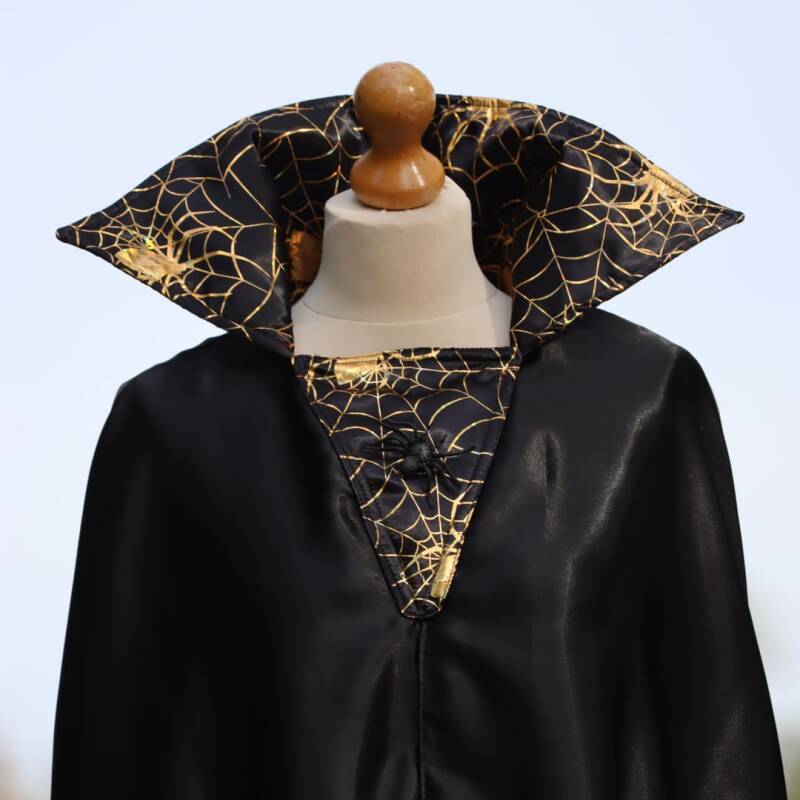
For me, the most important part of this cape is the collar.
It stands upright and creates that unmistakable Dracula silhouette.
I also found a beautiful golden spider print for the collar, and I immediately knew I had to use it.
There are fabrics and trims that make you stop sewing for a moment and think:
Yes. This is it.
The golden spiders were one of those details.
They are small, but they change the whole feeling of the costume.
Without them, it is a black cape.
With them, it becomes something much more sinister.
And much more fun.
The Dracula Look Is Not Really What Bram Stoker Described
Here is something I find fascinating as a costume maker.
The Dracula we know today is not exactly the Dracula Bram Stoker described in his 1897 novel.
In the book, Dracula is dressed in black, but the famous high-collared black cape with a dramatic red lining is not actually described in the way we know it from films and Halloween costumes.
So where did the famous image come from?
Theatre and film played a huge role.
A 1924 stage adaptation of Dracula helped establish the visual image we now recognise. The famous high collar was not only dramatic — it also had a practical theatrical purpose. It could be supported with wires and used as part of a stage trick in which Dracula appeared to disappear.
I love this.
A costume detail that looks wonderfully Gothic and mysterious actually had a very practical reason.
That is often the case with costume history.
What looks decorative may have a purpose.
And what looks completely impractical may actually have been designed for a very specific effect.
Why Does a Cape Look So Mysterious?
I think the answer is partly about shape.
A cape creates a long, uninterrupted silhouette.
It hides the shape of the body.
It moves independently from the legs.
And when the wearer turns, the whole garment moves with them.
That makes it theatrical.
A jacket can look elegant.
A coat can look impressive.
But a long cape can look almost supernatural.
It also creates shadows.
And shadows are very useful when you are trying to look mysterious.
Add a tall collar and suddenly the face is framed by the costume. Add a dark colour and a little red, and the visual language becomes very clear.
Vampire.
Gothic.
Dracula.
Halloween.
The Luxury Is in the Details
One of my favourite things about this cape is the combination of simple elements.
Black satin.
Red lining.
A tall collar.
Golden spider details.
None of these things are particularly complicated on their own.
Together, however, they create a strong costume.
This is something I always try to remember when making costumes.
You do not necessarily need hundreds of decorations.
Sometimes one beautiful fabric, one strong shape and one unexpected detail are enough.
The golden spider print was that detail for this cape.
It catches the eye without taking over the whole design.
Dracula and the Real History Behind the Name
And then there is Dracula himself.
Bram Stoker's novel was published in 1897, and the character became one of the most famous figures in Gothic horror.
Stoker did use the name “Dracula” after encountering it during his research into Romanian history. The connection between his fictional Count and the historical Vlad III Dracula, often called Vlad the Impaler, is much more complicated than popular culture sometimes suggests. Historians have debated how much Stoker actually took from Vlad III and how much came from other sources and vampire folklore.
So I would not say that Dracula simply was Vlad the Impaler.
He was a fictional vampire created by Bram Stoker.
But Stoker borrowed a very interesting name from real history and placed his imaginary Count in Transylvania.
And that combination of history, folklore and fiction has given costume makers an enormous amount of inspiration ever since.
From Gothic Literature to Halloween
Today, Dracula is almost inseparable from Halloween.
You can recognise a Dracula costume from surprisingly few details:
Black.
Red.
A high collar.
Perhaps a pair of fangs.
And, of course, the cape.
That is what makes this such an enjoyable costume to make.
It does not need to be complicated.
It needs to be convincing.
And convincing often comes down to silhouette.
If the cape has the right length, the right movement and the right collar, you are already halfway to Transylvania.
The rest is atmosphere.
Would Dracula Wear It?
I hope so.
I think he would appreciate the collar.
And the spiders.
Perhaps he would even approve of the satin.
Although I am not sure I would invite him into the atelier after dark.
One never knows.
Add comment
Comments